How to Write User Research Insights [Full Guide + Template]
Everything you need to know to write impactful user insights + a free insight template for Miro, Mural, and Figjam
Reading time: 29 minutes
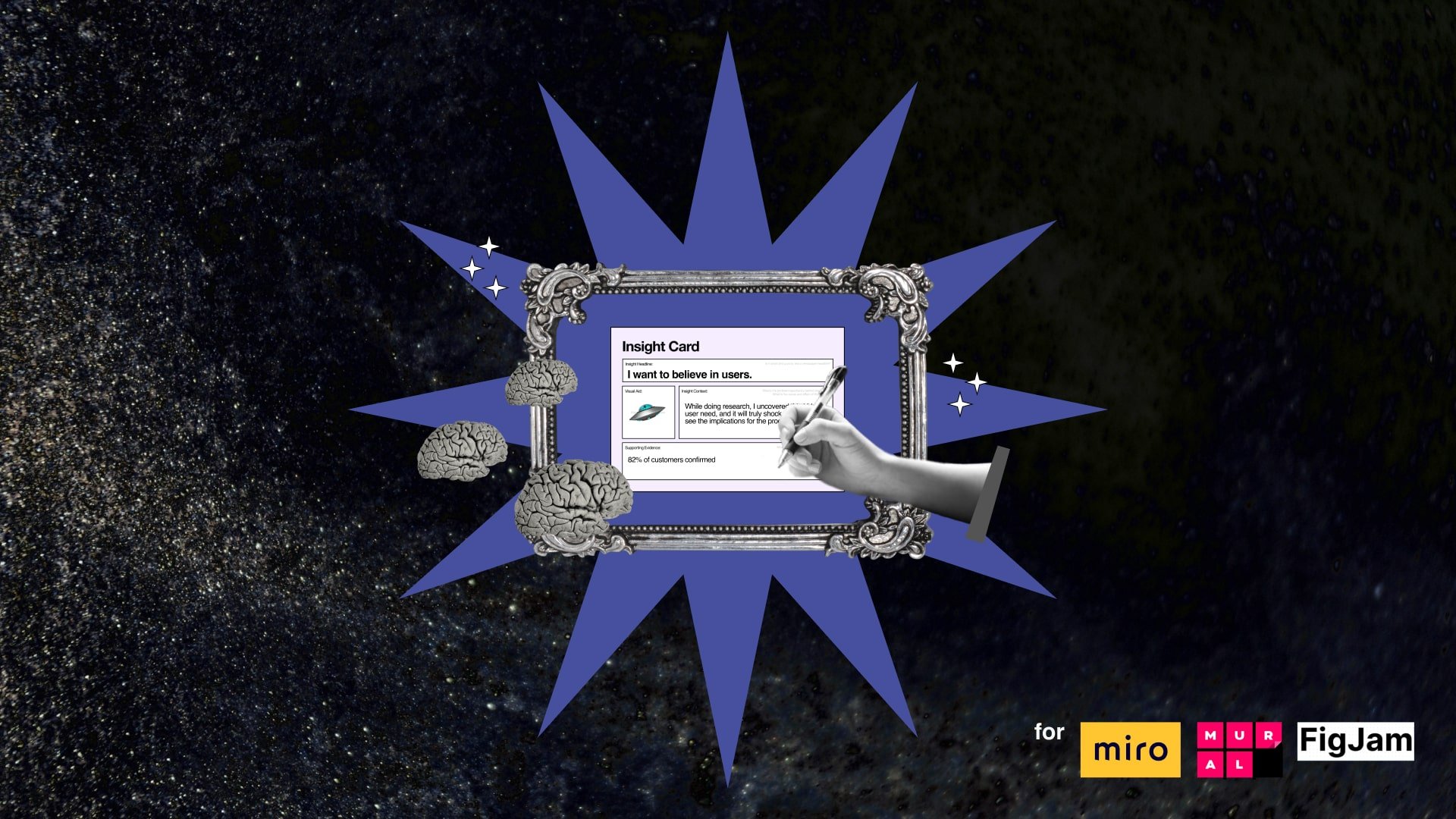
You're wasting your research efforts if you don’t know how to write a good user insight.
Insights are the most critical deliverable of user research. Sadly, there is little guidance on writing them. Researchers talk about the importance of user research and sharing user insights…but what about everything in between?
After a decade in design research, I want to gather all the best practices in understanding, generating, identifying, and writing user insights.
Luckily, writing user insights is a skill that can be learned.
What are user insights?
First, let’s talk about the nature of user insights because it isn’t always clear. Here’s my definition:
User insights are helpful revelations about people that help organizations design better experiences.
User insights are also commonly referred to as customer insights or consumer insights.
A regular insight is a surprising revelation, understanding, or learned meaning about a particular subject or problem. But user insights come from people's behaviors, needs, attitudes, and motivations related to a product or service. These epiphanies improve businesses and the customer experience.
Within organizations, insights are a way of framing learning and discovery around the user. They help to explain, clarify, or solve a problem or question. Insights are usually based on sudden realizations about the users or customers from research activities.
User insights deal with the future, and they try to predict it by uncovering patterns in human behavior.

Examples of user or customer insights
Insights come in various written formats, and there is no perfect format. Just like a design, the best insight is the one that helps you design the best products and services.
Here are a few examples of user insights:
“Power users want a distraction-free interface because they seek a flow state.”
“Our B2B users value dependability and have low trust for our product.”
“Web visitors won’t wait longer than 2 seconds for a page to load.”
“Customers are abandoning their carts at a higher-than-industry rate.”
“Free trial users need to read 3 articles by outside experts before purchasing.”
“Our early-adopter customers use at least 5 browser-based productivity tools.”
Imagine all of the products and services you could design around these insights!
While there is no rule about the content of an insight, user insights typically focus on the user's unmet needs, underlying motivations, and surprising behaviors.
The goal of an insight
Insights can help companies create products and services that intuitively meet user needs.
Insights can make a company’s users think someone is reading their minds because they make users’ hidden motivations visible. That allows organizations to anticipate the needs of their customers and find new opportunities for innovation or efficiency.
They might also reveal pain points or issues in user experiences. They spark new ways of seeing the world because they bring revealing perspectives and meaning from the user by uncovering new patterns in data.
Insights also play an essential role in bridging the research and design phases. Nothing gets a team excited to develop solutions like a paradigm-shifting insight. The phase between research and design is known as design synthesis, which is critical to translating problems into solutions.
Insights are “sparks of synthesis” that drive everyone who sees them to action. That’s a high standard, and that’s why insight generation is the most critical deliverable of user research.
Insight learning theory and the Aha! moment
Writing an insight is a cognitive framing activity that isn’t easy to understand. What’s going on in our brains when we have an insight?
The user insight approach is based on insight learning in psychology, where a sudden epiphany is attained by looking at the problem in non-linear or novel ways. This approach is handy when the problem cannot be solved through a step-by-step process (such as when complex factors like human perception or behavior are involved).
This epiphany goes by the name of the “Aha!” moment or the eureka effect because of a very famous story about Archimedes, one of the greatest scientists of the classical age.

According to legend, a newly elected general paid a goldsmith to make a gold crown for the temple. After the goldsmith made the crown, rumors circulated that it was filled with cheap silver. So the general gave Archimedes the task of determining if his crown was pure gold…without melting it down.
The task stumped the brilliant Archimedes. The crown weighed the right amount, so the goldsmith was either innocent or very clever.

One day, while bathing in the tub, the idea came to him in a jolt of inspiration. Archimedes noticed that his body displaced water as it sank into the tub.
He knew that silver had more volume than gold per weight. He realized that he could test the crown by immersing both the crown and a specific amount of gold to see which made more water seep out of the tub.
Legend has it that he was so excited he ran out into the night completely naked, screaming, “Eureka!” (which translates to “I have it!” in Greek).
Researchers often have similar experiences after collecting data. Insights may not strike you while you’re researching. It’s hard to schedule an insight with the complicated non-linear cognitive process that powers this inspiration.
Suddenly, while doing something else, you get an idea as your mind rearranges the problem pieces to find a new connection. When the mind finds this novel connection, you experience an Aha! moment as the insight is revealed.
A helpful framework for insights
When you’re just starting out, it’s helpful to understand the basic structure of an insight. Insight is made up of these parts:
“I saw this” + “I know this” = insight
Let’s break down each part of the framework:
“I saw this” - user research data gathered through research, ideally from various sources
“I know this” - accumulated life experience, worldview, and meaning for the insight creator(s)
Insight - deep, meaningful, and contextual perception
Example of the insight formula:
“37% of users abandon their shopping carts + I’ve never seen that happen in real life = There must be something seriously wrong with the checkout flow.”
This formula is a 1 + 1 = 3 relationship because insights are more than the sum of their parts. What you saw + know = something completely new.
This equation format helps you understand insights but isn’t compelling as a final format for sharing insights. After some feedback and editing, you could convert it to a final form without the equation.
Example of a finished insight:
“Nearly half of users abandon their carts because of the B2C checkout flow.”
This framework can help you form insights when you're new. I often use this framework to do a mental check of my insights. Read on to learn how to find, identify and write better insights.
Methods to uncover user insights
It’s hard to force an epiphany or “Aha!” moment, but there are things you can do to create a better environment for an insight to strike you.
User insights happen after you’ve gathered lots of data. Here’s how to get started:
Interview users.
Why not go straight to the source? Interviewing users is consistently rated as the top UX research method, and it’s a great place to start looking for insights. Insights may not strike you during the interview, but after talking to a few users, the user insights will start to roll in.
How to do it:
Interview 5-20 users using open-ended questions related to your product. Sort the resulting data in Miro with your team until themes emerge. Insights are most likely to strike while you study the interview data.
If you don’t have direct customer access, find look-a-like users or use surveys with a tool like Typeform.
Observe users.
To see a more realistic picture of the user’s perspective, try to observe them using a product firsthand. By observing the context of use (known as design ethnography), you can get a realistic idea of their everyday life without biases that might influence their honesty.
How to do it:
Observe 3-10 customers using your product in their everyday lives. Ask follow-up questions to get at their underlying motivations. Insights will likely emerge as you notice surprising behaviors.If you can’t directly observe your users, use analytics or watch them a listening tool like Hotjar.
Experiment with users.
How do you get user insights about new ideas? Like observing, experimenting is a way to reveal insights by testing prototypes and live designs with users. By setting up simulations, you can learn about specific future behaviors or get targeted learnings about underlying motivations that might not be possible with a fully-built product.
How to do it:
Design a realistic-feeling prototype for 5-15 users. Give them a task and see how they perform. Ask follow-up questions to get at the underlying attitudes behind their behaviors.
If you don’t have customer access for experimentation, try an A/B test, First-Click Test, or survey. (read more about experimentation here)
Conduct desk research.
Why do research from scratch when it already exists? You can find lots of research already ripe for insights in your company’s intranet or even on Google. Known as desk research or secondary research, reading inspiring research from other people is a great way to get user insights in between other research methods.
How to do it:
Look for past research projects on your company’s wiki that might be relevant to your current issues. Other sources might be industry reports, marketing white-papers, and scientific articles.
If you can’t find any past research, use a site like ProductHunt to find similar products with similar users. Once you identify a similar user, read reviews, blog posts, and any research that might shed some light on your shared user.
Analyze research data.
Are you maximizing the research data you’ve already gathered? Analyzing is a key step of working with your research data, and it can happen after doing any of the steps listed above. You can find recurring themes and new connections by taking apart research data from the past. Insights help you bridge research with design.
How to do it:
Clean your research notes and format them for others to consume. Prune, edit, and re-sort your notes while keeping your mind open to insights. To encourage this process, remind yourself of your current research goals as you comb through your data.
If you don’t have research data yet, use steps 1-4 to gather some.
Think creatively.
Can you force an insight without doing research or looking at research data? Yes, if you already have a good understanding of your user, you can use various re-framing activities to look at a problem from multiple perspectives. You might use a user persona to re-frame a problem from the user’s perspective.
How to do it:
Start by getting acquainted with the data that you have on your customer. Once you are familiar with the data, walk through the steps of a user flow from the perspective of the customer. Augment your imagination with analytics or other data. See if new insights strike you as you imagine your product from multiple angles.
WARNING: Be careful about roleplaying the user. Without user data, you might be pretending without behavior to back up your assumptions. (for more on the danger of roleplaying over research, read about the concept called UX Theatre)
Take a break.
Do you always need to focus a conscious effort to form a user insight? Absolutely not. Sometimes you need a break. User insights often strike me while I’m taking a shower. Our brains need time to incubate before forming meaning, and taking a break gives our subconscious mind the time to sort out all the things we’re learning.
How to do it:
Once you’ve started a few rough drafts of some user insights, take a break. Go for a walk. Get a coffee. Stare at the wall, even. Let the boredom sink in, and your mind will start forming connections after a few minutes.
How to identify user insights
What is not user insight?
When sharing insights for the first time, you might find that your stakeholders don’t share your enthusiasm for the insight. Here are some things to avoid so that your insights can reach their full potential:
Insights aren’t a single data point.
Insights don’t just tell you what happened. More than a single piece of information, insights connect multiple data points. If you have insight from a single customer quote or instance, look further for the connections behind this information. An insight should be bigger than a single piece of information.
Insights aren’t customer wants and requests.
Don’t confuse a single customer’s desire for an insight. An insight should be built on a group of customers’ desires and reveal the underlying need for the desire. When researching, customers will come to you with their requests, and it may be tempting to treat that like an insight. Look deeper for an underlying motivation that could connect the customer's request with other customers’ requests.
Insights don’t justify already-held beliefs.
Insights should be surprising and critical for changing people’s minds in your organization. If an insight confirms already-held beliefs, treat it like any other piece of data and let it inform future insights.
Insights aren’t universal and everlasting.
Insights gathered in one context may not necessarily transfer to another. Be careful about copy/pasting insights from one project into another. The questions that made an insight an insight will often differ in the next project. Once the organization has digested the learning within your insight, it’s best to move on and find fresh insight.
Insights aren’t solutions.
Insights aren’t solutions, but they should inspire solutions. If you’ve got an insight where only one solution is possible, then you don’t have an insight. You have a solution idea.
What is user insight?
User insights are surprising revelations about users that help the business. Your ultimate goal with insight is to turn it into company wisdom. To do that, you must be clear on what an insight is.
Here are some criteria to help you judge the insights that can help you improve outside of feedback from your stakeholders:
Insights provide explanation and meaning.
Insights should inform why something is happening. Insights can give you surprising learnings that can help you understand the true nature of a phenomenon. They can help you form a deeper meaning of issues.
Insights reveal new patterns and connections.
Insights are “sparks of synthesis,” meaning they help you zoom out and understand the broader context. They do that by revealing patterns within multiple data points. They should help you make sense of a context by unlocking a new pattern or perspective.
User insights reveal customer needs and underlying motivation.
User insights allow you to make educated guesses about the background thinking of customers. Going deeper into the user's psyche, you can start to predict what they will want or need, a valuable outcome of user insight.
Insights challenge assumptions.
Insights reveal new paradigms rather than enforce old ones. If your insight doesn’t push the envelope. If there isn’t a little bit of controversy, it’s probably not a good insight. Insights challenge the existing status quo and seek to make organizational change.
Insights can inspire multiple solutions.
Insights should inspire multiple projects. It might be too narrow if only one solution is available from your insight. Create insights that can inspire future work without specifying the exact solution.
How to write compelling user insights
How do you format an insight? When you’re new to research, it’s hard to get started knowing that the whole company might see your insights.
Here’s a process you can use to write compelling insights:
Summarize the learning in a memorable headline
The biggest mistake I see researchers make is to make their insights too long. Write something short and punchy for the stakeholder to attach to, otherwise they won’t be able to remember the thesis of the insight.
It’s always a challenge to distill your learnings into one sentence, but it’s worth the effort. Think of the headline like a newspaper headline. Would you read the story? Keep the headline to one sentence. The Insight Card has limited space here on purpose. Keep it brief!
Pro Tip: Make your headline a hook that tantalizes the stakeholder to read further without giving them the full story.Include the context of the learning
After writing your memorable headline, give the rest of the context. Here’s your chance to dive into the details. I would recommend that you include:
The problem inherent in the insight
The opportunity surrounding the insight
The cause and effect (if it is known)
Pro Tip: Include the project, type of user, and domain that will be affected by the user insight.
Include supporting evidence
An insight should be based on data, so be sure to include the evidence that informs your big insight. This could be qualitative data points like quotes and videos from user interviews. It might also be quantitative analytics from your product. Whatever the source of your inspiration, include the proof to make your insight more compelling.
Pro Tip: If using the Insight Card in Miro or Figjam, include a screenshot of the data + a link so your stakeholders can jump into the raw data if they like.
Add a visual to make the insight more memorable
Adding a visual to your insight is a great way to weaponize our brain’s ability to remember visuals. Visuals can also help your stakeholders understand an insight by providing a subtle visual cue. Even a simple emoji can go a long way in helping stakeholders to understand and remember what your insight is all about.
Pro Tip: Use a tool like DALL-E to create a visual about your user that is anonymous.
Sharpen the insight through feedback
Insights have to be edited to reach their max potential. Since the beauty of an insight is the in the eye of the stakeholder, ensure that you seek feedback from your stakeholders to improve the insight.
There is a tendency to fall in love with our own insights. Remember that the true power of user insights is in their effect on stakeholders. Study the effect and try to distill the insight into a purer form based on feedback from your user.
Pro Tip: Write the user insight WITH your stakeholders rather than presenting them. If your stakeholders feel the insight comes from them, they’re more likely to act on them.
If you follow these five steps, you will end up with an insight that sticks in the hearts and minds of stakeholders.
Examples of user insights
The Insight Card is a template that I designed to help people get better at writing user insights. Let’s use the card to look at some examples of insights from current and potential customers of various organizations.

In this example, we see that this user insight reveals some surprising behavior in a group of customers. Imagine you are at a company that charges for one seat at a time. Once you realize users are all sharing the same account, it will change everything you design afterward. This is an excellent example of how insights challenge assumptions.
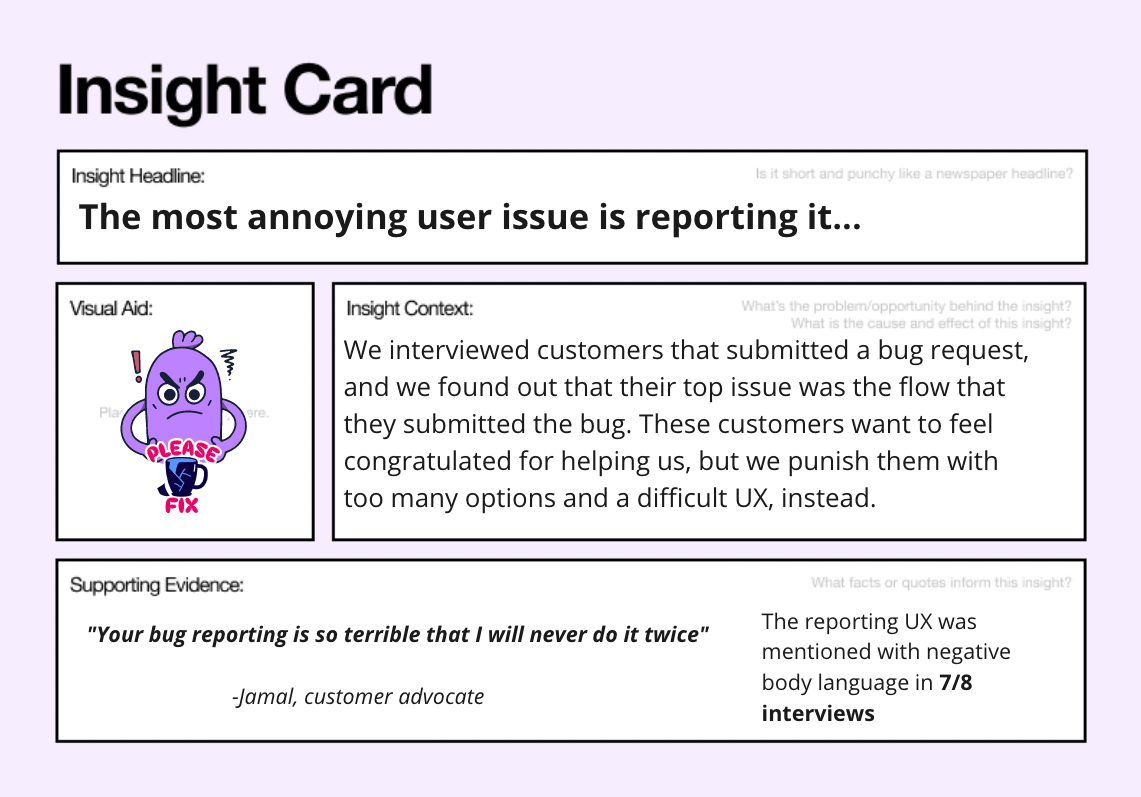
In this example, researchers made a surprising discovery about how users report bugs. It can give the team an insight into the underlying motivation for writing bug requests and offers a quick user insight that’s easily fixed. It’s not groundbreaking, but it’s essential to know.
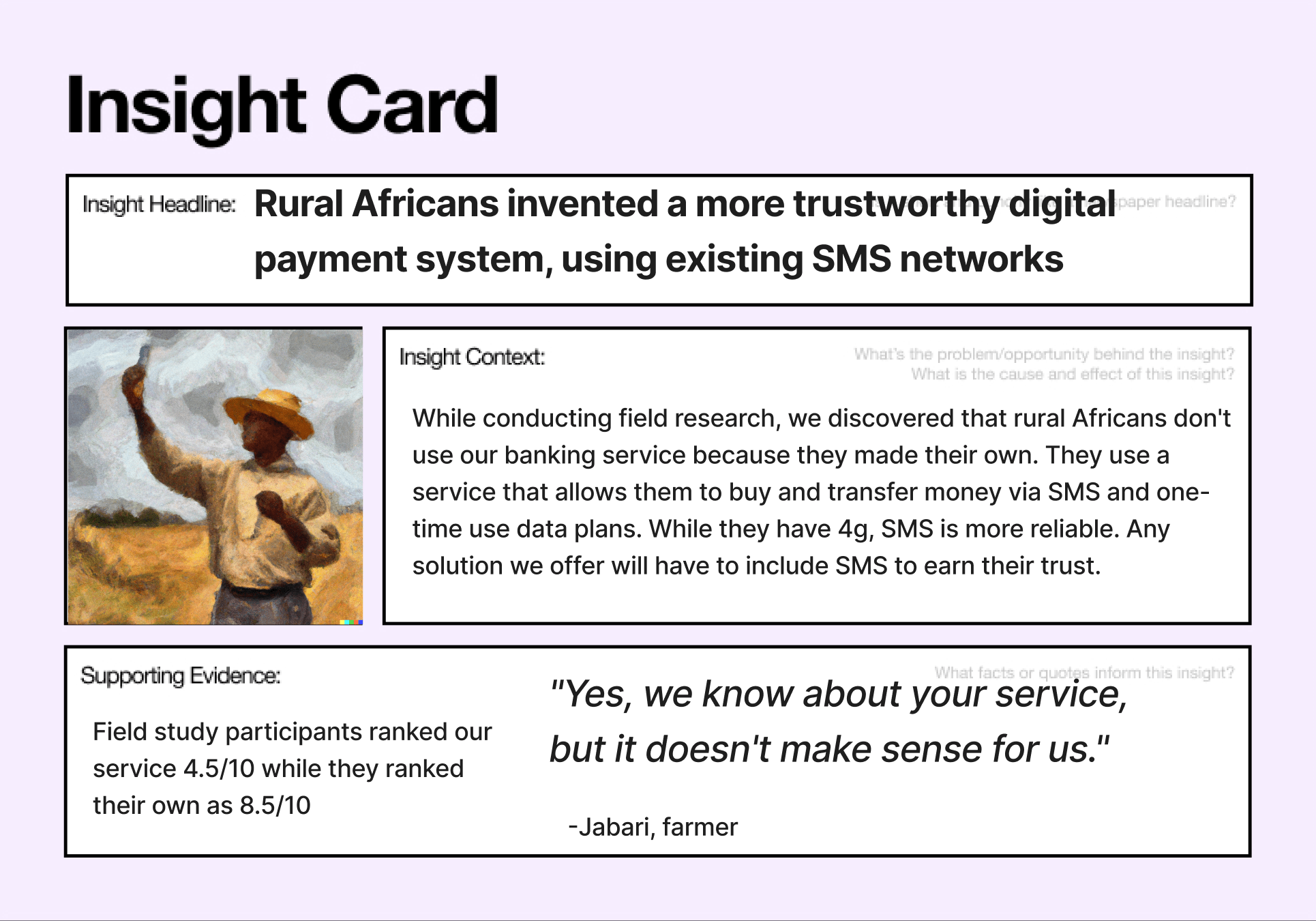
In this insight, researchers discover that the value proposition of a new service in Africa was completely wrong for the market. Imagine offering a phone data service based on assumptions, and then discovering that a better service existed the whole time. Any executive at the company would need this insight ASAP. This is an example of how a well-written insight can distill lots of research into a single, business-changing epiphany.
Presenting user insights
After writing user insights, you still have the difficult task of presenting them. The Insight Card is a great way to start writing insights, but you will probably want to format them differently for the presentation.
Here are the top 3 ways to present user insights:
Slide deck using a tool like Google Presentations
Static PDF using a tool like Notion to export it
Interactive workshop using a tool like Miro
Read 10 more ways to present user research insights here→
Who should you be presenting these insights to? Are they meant for your researcher’s eyes only? An important thing to remember is that you are not the intended audience of your insight.
Stakeholders are the most critical audience for user insights.
Like a design, the best insight is the one that works for the audience. Insights aren’t meant for researchers; their audience is your stakeholders. Knowing that, use whatever format will work best for your stakeholder.
Insights are context-dependent, so an insight at one company might not be at another. Since insights are subjective, it’s hard to say whether a user insight is good.
The beauty of insights is in the eye of the beholder...your stakeholder.
Even poorly formulated insights can be impactful if stakeholders love and use them. But if you use the tips in this article, you will have a better chance at writing insights that become company wisdom.
Download the User Insight Template
The Insight Card is a template that prompts you to think about context, evidence, and the memorability of your user or customer insight. It’s a free asset for Miro, Mural, and Figjam that can help you track your insights visually.
The card has all the right prompts for writing impactful insights. It also has a helpful chart for judging the value of your insight and a checklist to help you improve your insight.
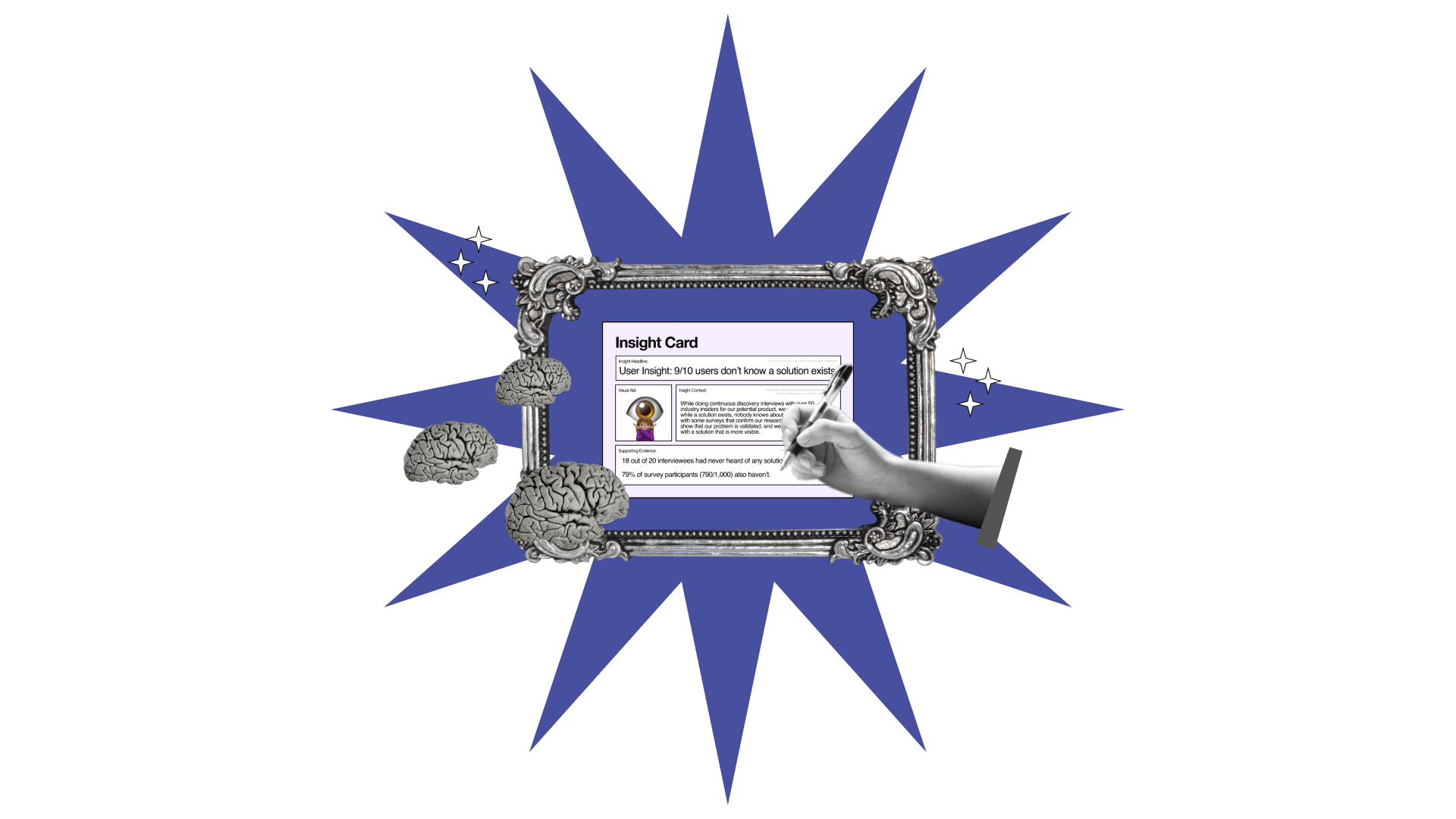
If you want to get better at writing insights, this card will help you get started in the right direction.
Learning Resources for User Insights
Download the Insight Card to manage your insights in Miro or Figjam
Read more about the theory behind user insights in Insight Learning (Definition + Examples) by Practical Psychology
Read an overview on Sensemaking in Making Sense of Research with a Sense-Making Process by Jeff Humble
Read a deep dive about the theory and thinking behind user insights in Abductive Thinking and Sensemaking: The Drivers of Design Synthesis by Jon Kolko
Read What are insights? by Arnav Kumar
Read about how to present insights beyond the research report in 10 Ways That UX Research Report Could Have Been Shorter by Jeff Humble
Watch an excellent talk about user research and user insights called Just Enough Research / Erika Hall - UX Salon 2016 by Erika Hall
Watch a talk about The Phenomenon of Synthesis by Jon Kolko
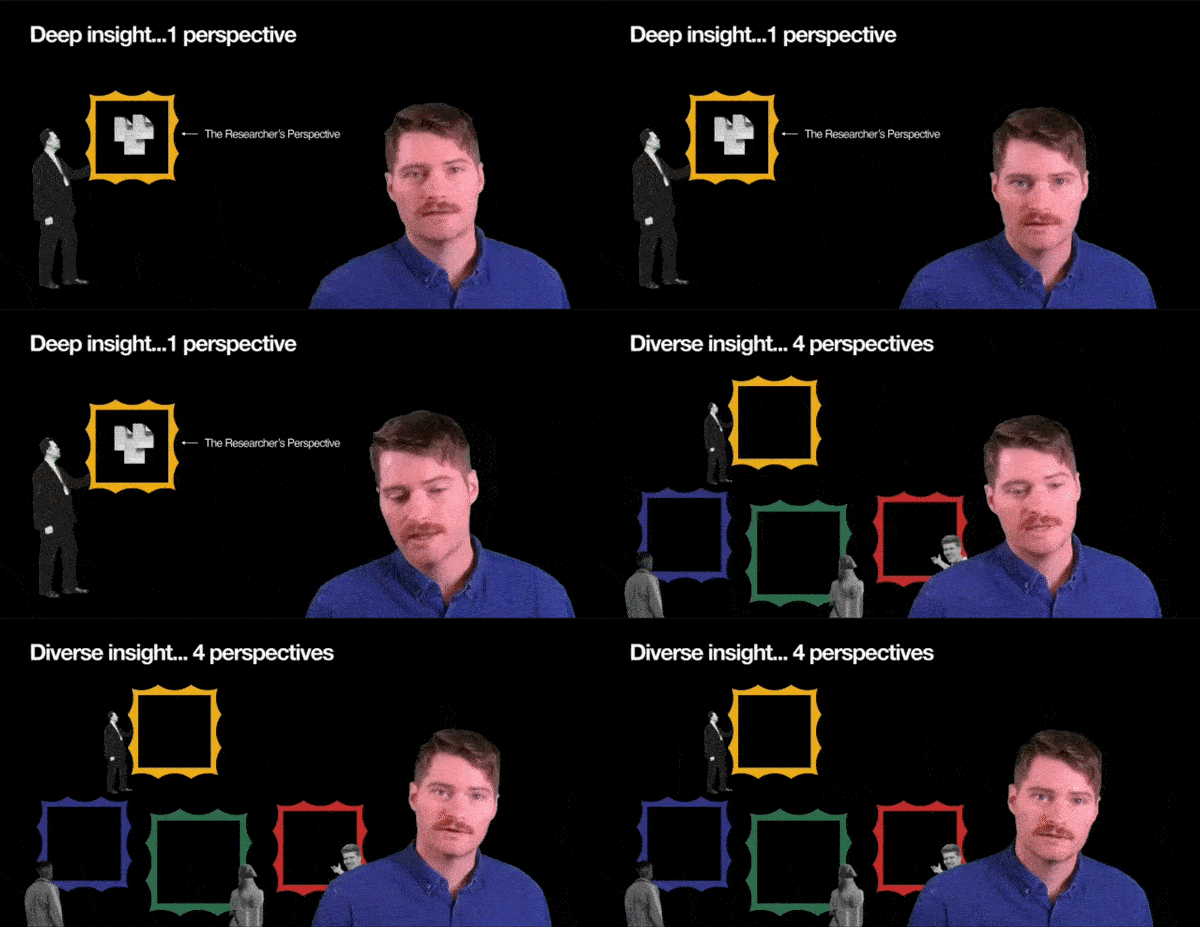
Unlock Your Research Potential
Watch this 60-minute masterclass on how to use insights in a continuous research system. This talk will give you a system to use the Insight Card at your company.

![How to Write User Research Insights [Full Guide + Template]](https://images.squarespace-cdn.com/content/v1/5dc5935a7224ad2839d7e750/1675267033185-M8VCTMNY0VJUU988U4J1/Insight_Card-Blog-Thumbnail.jpg)

![What is Product Discovery? [Process, Methods, and Benefits]](https://images.squarespace-cdn.com/content/v1/5dc5935a7224ad2839d7e750/1665227887540-3TFXCIV7QZQTDMRNVEXJ/What_is_product_discovery-Fountain_Institute%28thumbnail%29.png)


What frameworks or templates help you harness the power of insights?

Learn how a UX designer set up continuous research in their product organization for the first time.