What Is UX Theatre and How Do You Avoid It?
Find out if you’re only acting user-centered and what you can do about it.
Reading Time: 10 minutes

Have you ever worked on a project where there is a lot of talk about users but no actual users involved? When roleplaying the user becomes a replacement for talking to users, you might be dealing with UX Theatre.
What is UX Theatre?
UX Theatre is acting like you're user-centered. It's paying lip service to users without talking to them.
Coined by Spydergrrl, this term is a real sign of the times.
As UX goes mainstream, executives, agencies, and marketers are eager to capitalize on the popularity of UX. But talking about user-centeredness isn’t enough.
You have to involve the user.
Organizations encourage UX Theatre by hiring UX designers without giving them access to customers or customer data. Being good at user experience design is tough when you can’t talk to users. Some might say it’s impossible.
UX Theatre in Action:
Executive: “Can’t we brainstorm to determine what features to build? I thought you UX designers were good at workshops and design sprints?”
Product Manager: “We use user stories and personas to imagine what it’s like to be the user. We don’t have time to do user interviews or research.”
Developer: “Can’t you think like a user and design something? You’re the expert on users!”
How do I recognize UX Theatre?
When you're new to UX, you might even be doing UX Theatre yourself. How do you know if you’re wandering into Theatre territory? Here are some ways to recognize UX Theatre:
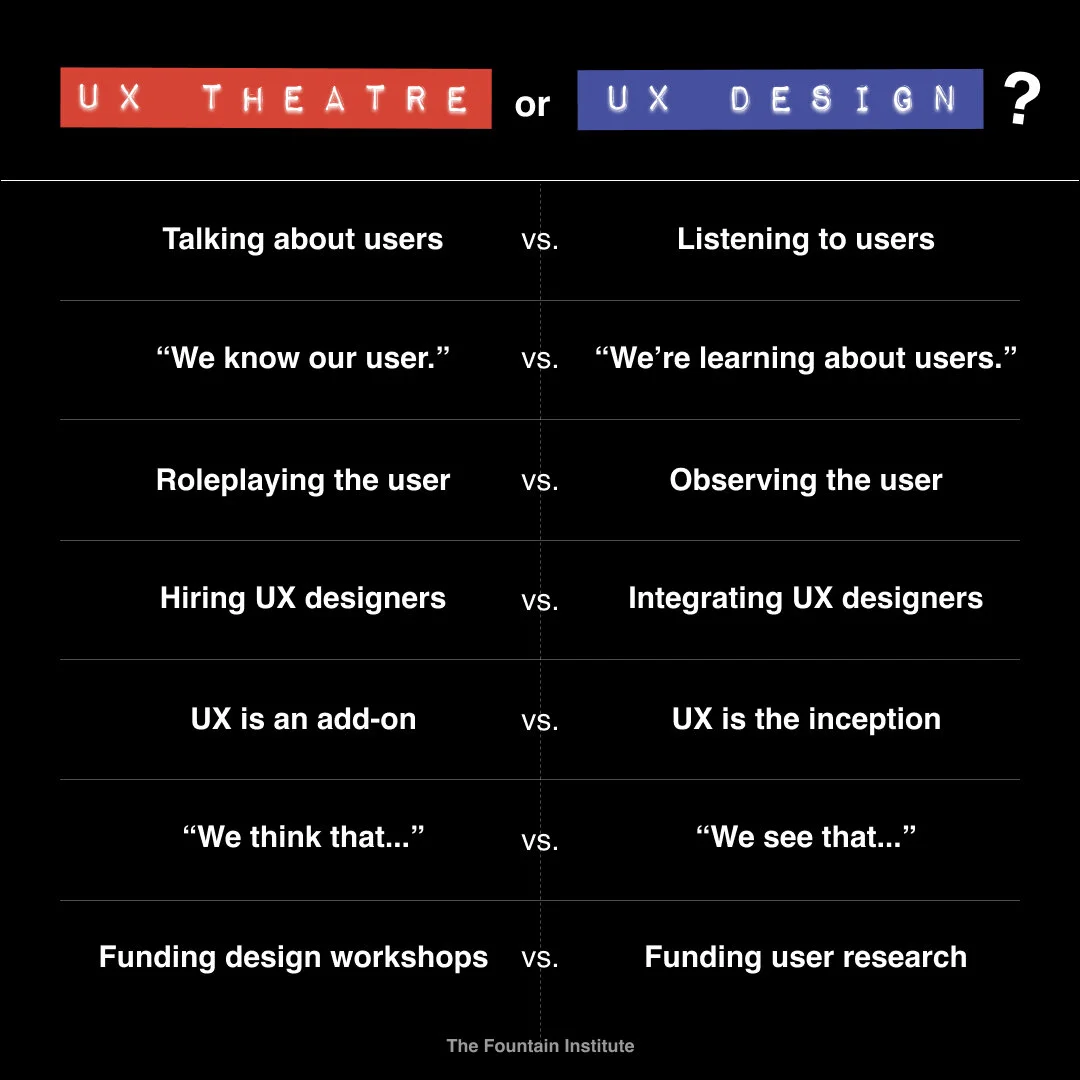
Examples of UX Theatre
Are you starting to get the idea? Here are some more concrete examples of UX Theatre so that you can avoid it in your design work:
Adding usability testing to the tail-end of projects without leaving time for adjustments is UX Theatre.
Pretending to be the user in a workshop instead of talking to users is UX Theatre.
Copying competitors instead of looking for customer needs is UX Theatre.
Filling out a persona template after barely talking to users is UX Theatre.
Sending out a biased survey and pretending that's user research is still UX Theatre.
Never talking to users directly… Yep, UX Theatre
(That last one hurt, didn't it?)
How do I stop UX Theatre?
The Good: UX Theatre signifies that your company cares about design.
The Bad: You will have to show (not just tell) your colleagues what user-centered design is if you want to fight UX Theatre.
The Ugly: Fighting UX Theatre and advocating for the user is something you will have to do for the rest of your career.
So how do you do it? Here are a few things you can try:
1.) Involve stakeholders in research
Companies practice UX Theatre primarily because they don’t know about authentic user-centered design. So show them! Invite them to interviews and tests or show them recordings.
Once stakeholders see users struggling to understand their ideas, they’ll quickly realize how many assumptions they were making.
2.) Connect research with “design”
To most people, design is all solutions. You have to show them that research and problem work improve what they know as “design.”
If you keep research to yourself, how is the team supposed to know when your designs are inspired by what you found in research?
Design is known for its outputs, like sketches and prototypes, but user data is the input that makes the outputs user-centered. Make sure that you connect those research inputs with the visual outputs they inspire.
3.) Show your work
We’re taught to show how we solve problems in math class. Imagine if mathematicians hid their chalkboards! Math would seem like magic. Why should designers not show their work, as well?
Design isn’t magic, and showing your work will prevent non-designers from thinking it’s magic.
Take the time to show how the user is involved in every step. Don’t let your stakeholders think those intuitive designs came out of your head.
Explain your steps to arrive at a solution, and you will build trust in the user-centered design process.
A Script to Fight UX Theatre
If you’re new to UX design, you’re probably doing UX Theatre in one way or another. As you build your user-centric lens, try these lines to fight UX Theatre at your job.
You, the UX-Theatre-Aware Designer:
You: We don’t have to guess what users will do. We can de-risk this decision by researching and gathering more data before we waste time building something nobody wants.
You: Without talking to real users, we might end up creating solutions to our problems rather than our users’ problems.
You: If we only consider the UX at the end of projects, it’s too late to put the user at the center of the process. If it’s not user-centered, it’s just UX Theatre.
You: Using post-its and workshops doesn’t make it UX design. If all we do is build our ideas without talking to users, that’s only pretending to be user-centered.
You: Empathy and roleplaying aren’t enough to be user-centered. The sooner we get out there and talk to users, the sooner we realize how wrong our assumptions were.
Learn More About UX Theatre
Read the original article from Spydergrrl called UX Theatre: Are You Just Acting Like You're Doing User-Centered Design?
Read Spydergrrl’s piece in Fast Company Co.Design: UX Design Has a Dirty Secret
Listen to an interview with Spydergrrl on UX Podcast Episode #267 UX Theatre
Get the Poster from Spydergrrl
[Download the high-res poster for your office from Spydergrrl’s Blog]