How to Go from Reactive Design to Proactive Design with Strategy
Learn how to stay ahead of the game by being proactive and strategic
Reading time: 30 minutes
Jump to a section:
Some designers spend their whole careers reacting to other people's moves.
As a product designer, it’s easy to find yourself constantly reacting to stakeholder demands, emerging design trends, or competitor features.
This reactive approach can lead to a fragmented user experience and burnout. Shifting to a proactive, strategic mindset enables you to shape user interactions intentionally and align design decisions with long-term goals.
Being reactive means somebody else is in control
I remember being in this reactive position as a design manager. I had to brace myself every Monday morning for some radical change in company direction. We never knew what the new agenda would be, but we knew that it would throw our work into chaos. Sometimes, all it took was for the founder to read a single article to change the company agenda. When a competitor released a new feature, the reaction was even worse. Everything had to stop until we figured out how to deal with the competition.
The whole company forced the design team to react constantly to the changing whims of leadership and the competition.
When deadlines, competitors, and continuously changing goals prevent you from doing the necessary design work, you are stuck in reactive design.

[GIF by thechemicalbrothers]
Reactive design is a neverending stream of tasks assigned by somebody else. Even design managers can find themselves in this position.
The worst part about a reactive mode is that you don't control the speed, so you can't even establish a routine of reacting.
This is a very unstrategic position because you will spend all your energy fulfilling other people's orders and never take the time to be proactive or strategic about your design practice.
Reactive design is the opposite of strategic design
This approach of reacting to your environment instead of actively shaping it is the opposite of strategy. It involves letting competitors, trends, or even customers distract you from being strategic.

[GIF by @dualvoidanima]
Signs you may be in a reactive mode:
Unfocused design work with no uniting theme: a shotgun approach wastes time and resources.
Building everything the customers ask for: While it might feel good to grant every customer request, your customer only knows what’s best for them. You have to figure out if it’s good for the business.
Building everything the sales team asks for: Salespeople are highly incentivized to promise customers the world, but this isn’t always good for the company in the long term.
Copying stuff that worked at other companies: This is usually a manager reacting to something that worked at a past company without adapting it to the current company.
Chasing the trends: This is tough, as people often see design as a way to stay trendy. However, trends can distract you from forging a unique path that makes sense for your company.
Chasing maturity levels: Not every team must reach the same maturity level. Companies require different design skills and processes, so don't react to the design industry's cookie-cutter approach. Customize to your company, not industry standards.
Trying to out-design the competitors: While it may seem intuitive, you don't want to try to beat the competition at their own game. This requires way more effort than proactively forging your strategic direction.
There’s nothing wrong with these reactive approaches on their own. You can follow trends, and it might improve design. I’m just saying that being proactive and company-specific would be way better.

[GIF by dualvoidanima]
The only way to escape the reactive loop is to start being proactive.
Signs of a proactive (and strategic) design practice:
Focusing on the essence: Doing fewer things better can save time and resources.
Making choices about the future: Decide beforehand which direction you will take.
Doing the opposite of the norm: When the competitors zig, you should zag.
Building to be different: Only take action when it aligns with the strategy’s direction.
Doing more with less: Rather than fight a losing game against competitors, do your own thing and carve out a defendable niche.
Steve Jobs is a good example of a strategic CEO who was very proactive. He was so proactive that it sometimes felt like he was a decade ahead of the competition. He took a single technology, touchscreen interfaces, and built product lines like the iPod, iPhone, and iPad out of it. Today, the market struggles to compete with the seamless blend of software and hardware that Apple pioneered. The strategic niche that Apple created with personal computer devices has held for decades.
You don’t have to be the CEO to be proactive and strategic. Sheryl Sandberg was the Chief Operating Officer at Facebook in 2008, when Facebook was growing at an insane rate but didn’t have a plan to get to profitability. Sheryl pioneered data-driven targeted ads in the news feed, a radical departure from banner ads. This monetization strategy enabled Facebook to dominate the ad business, a proactive move that still earns Facebook millions.
You don’t even have to create an artifact like a presentation deck to be strategic. Katherine Johnson was a NASA mathematician during the Apollo missions. At the time, many women did complex calculations by hand but were not included in critical decision-making processes. Katherine realized that this could have dire consequences during emergencies. She inserted herself into critical conversations and pioneered computer-aided calculations so that her strategic approaches could prevent disasters.
The most successful people don’t wait for events to unfold. They design outcomes to their advantage, and strategy provides the tools to do that.
What is the purpose of strategy in design?
What does strategy actually do for us as designers? More than a plan, it’s developing a theory for thinking and working on the future that helps us move from reactive to proactive thinking.

[GIF by dualvoidanima]
Max McKeown gives us a nice overview of what strategy does for us:
"Strategy is about shaping the future…Brilliant strategy is the best route to desirable ends with available means."
Michael Porter is one of the most famous strategists. I like how he describes its purpose:
“Strategy is about setting yourself apart from the competition. It's not a matter of being better at what you do - it's a matter of being different at what you do.”
Being proactive will improve your future, but strategy will help you shape it actively. Design strategy activities almost always have a higher return on investment than other design activities at work.
Here’s how strategy work is different:
It’s about focusing on fewer options: Instead of considering every opportunity from scratch for every project, a clear strategy automatically rejects misaligned options.
It’s just as much about what you won’t do as what you will do: Constraints create focus, and saying no to the wrong things enables the right things to thrive.
It helps you deliver like nobody else can. Strategy is about finding your unique edge and embracing it.
It turns weaknesses into strengths: When resources are limited, a great strategy finds ways to win with what you already have.
It compounds over time: Just like good investments, good strategic decisions build on each other to create a long-term advantage, especially if you evolve your strategy with time.
Even a bad strategy can provide some of those benefits; at its worst, it will still make you think about the future, so it’s always a good idea.
How reactive thinking is disguised as strategy
Many companies go through the motions of making a strategy and end up with something reactive disguised as a strategy.
Design strategies should start by aligning with the higher-order strategy likes business strategy, but that can be hard if your business strategy is reactive.
You're missing the point when your strategy is built on reactive thinking. Strategies about “being the leader” and “becoming #1” are often reactive, thinking about competitors in disguise as a strategy.
Here’s a common scenario of reactive strategy:
See the competition release a new feature.
Create a quarterly goal to get the team to copy the feature.
Push the team hard to get it done in a quarter.
Never take the time to measure the impact of the feature.
Find a new competitor feature to copy next quarter and repeat.
After a few quarters, invent some grand, unreachable vision that rationalizes the quarterly goals to make it seem like the current trajectory is part of some plan.
Call this Frankenstein of goals, vision, and reactivity a Strategy.
We become short-sighted when we chase disparate goals like carrots on a string. After several quarters of chasing random goals, you might wake up and not know what your company stands for anymore.
To avoid shortsightedness, you’ll have to find the time to get ahead of it. You’ll have to figure out how to be proactive, and strategy is a whole methodology for doing that at a high level.
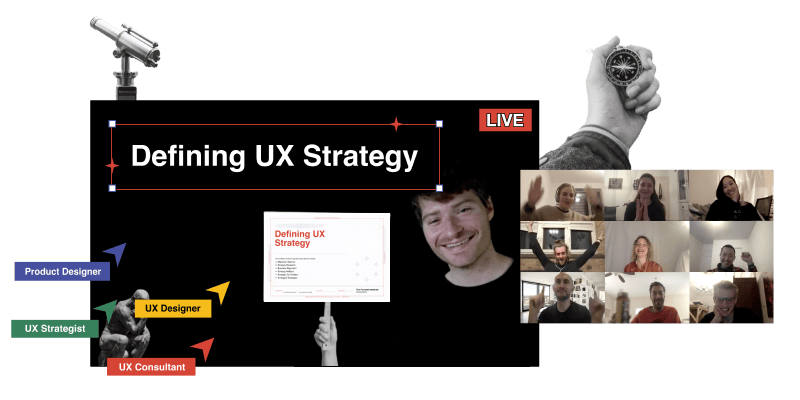
Learn how to design strategy in LIVE, online classes
Join this project-based program for designers that want to learn how to design winning strategies for UX, product, and business.
Examples of companies being proactive and strategic
At an individual level, strategy allows product leaders and teams to work smarter, not just harder. But what does this look like in practice?
Here are some real-world examples of strategic companies that have used strategy to proactively set the future of competition in their markets.
Airbnb’s shift from renting air mattresses to an experiences platform: Airbnb could have stopped at merely competing with hotels, but they decided to strengthen their competitive advantage with their strategy to redefine the entire industry around experiences. This allowed Airbnb to define this new travel category rather than fight price wars with hotels.
Nike’s move toward direct-to-consumer shopping: For a long time, Nike relied on third-party retailers like FootLocker, and its efforts were focused on beating competitors within those stores. In the early 2010s, Nike changed its strategy by selling its clothing on its website, apps, and flagship stores, allowing it to take control of its customer relationship.
Basecamp’s focus on a calm company culture: In a world of productivity tools obsessed with growth at all costs, Basecamp’s strategy was to optimize for long-term sustainability over hypergrowth, ensuring profitability and resilience. You can peek at this contrarian philosophy in public-facing docs like the 37signals Guide to Making Decisions.
Shopify empowers small businesses: Shopify didn’t just build another e-commerce platform like the market dominator Amazon. Instead, it provided small businesses with enterprise-level tools, betting on the rise of independent online stores rather than the big behemoth Amazon.
These examples show that strategy isn’t about working harder or chasing the latest trends. It’s about making calculated choices, committing to what will set you apart, and building an approach that creates leverage over time.
The benefits of having a design strategy
I’m not going to lie to you. Shifting to proactive takes a lot of work. But know that a clear design strategy gives you many benefits:
Say no with confidence. Not every opportunity aligns with your design team’s goals, and strategy provides a filter for decision-making.
Create work that compounds. Instead of spinning in circles, the strategy builds long-term momentum for your design team.
Find leverage. The most effective teams don’t outwork everyone; they work smarter. Finding a lever as a design team can help you do more with less.
Avoid getting lost in complexity. A good strategy cuts through the noise and ensures every design decision builds on a long-term vision.
Turn constraints into competitive advantages. The strategy allows you to use limited design resources more effectively than companies with more money or human power.
Position yourself to win. Instead of responding to design trends, set them. Make your own game rather than playing someone else’s.
While these benefits won’t last forever, they will last much longer than the quarterly cycles of reactive thinking.
A template for crafting a design strategy
While there is no easy formula for strategy, there are specific criteria that you need to include. What should go into a UX strategy? What does the process look like?
That’s why I created the Strategy Canvas. It’s based on the thinking of top strategists in the field, like Richard Rumelt, Stephan Bungay, and Henry Mintzberg. I use it to teach design leaders to create winning strategies in my course, Defining UX Strategy: LIVE. It prompts you to think about all the relevant aspects of a UX strategy and nothing more. It also makes a great collaborative artifact that you can use to share the burden of designing a UX strategy.
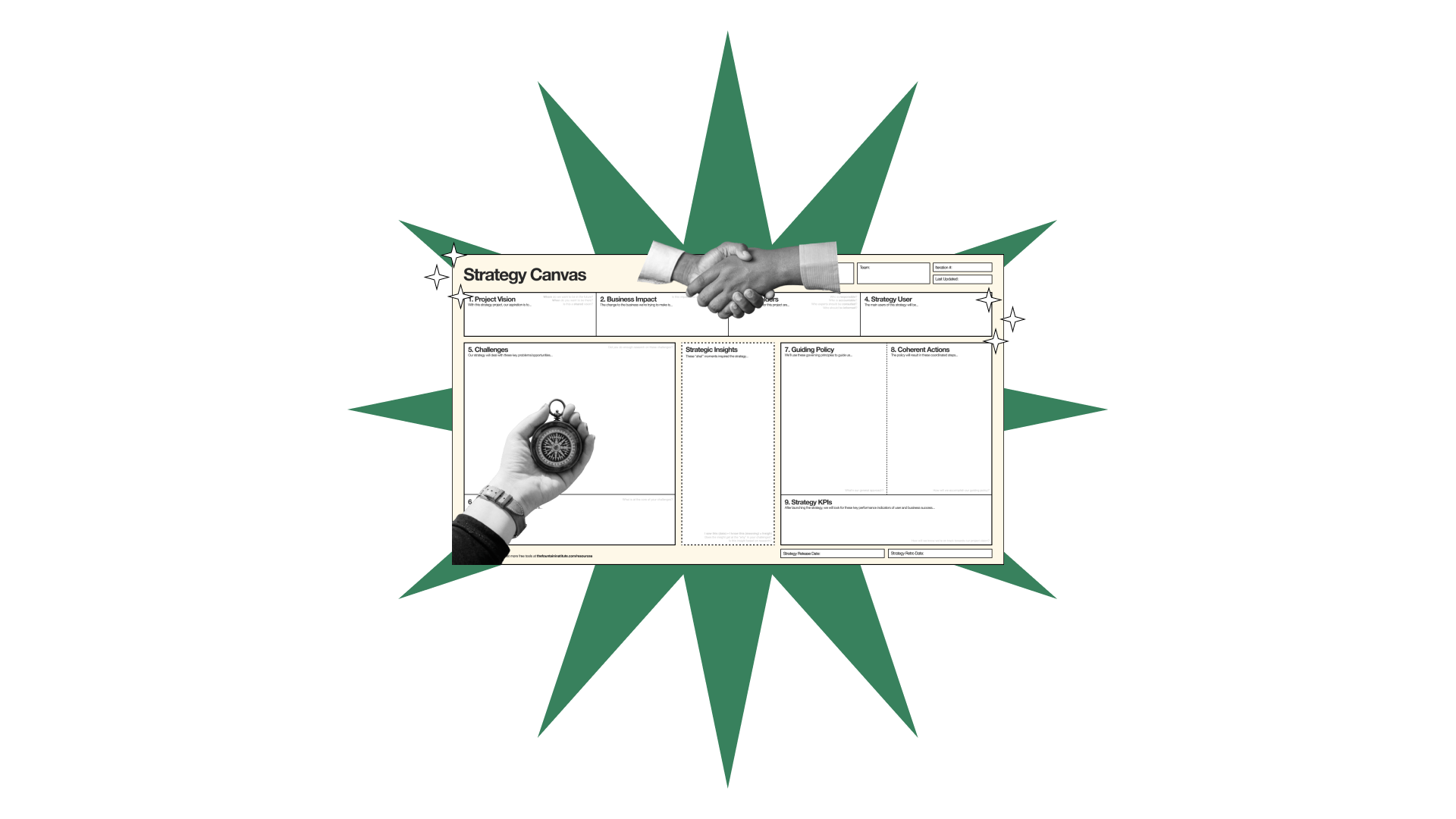
Use this canvas as a starting point for your strategy design process. You can use the filled-out canvas to get feedback and explain your approach to stakeholders. After it’s been thoroughly vetted, you can take the thinking in this canvas and transform it into common UX strategy artifacts like the two-pager or a slide deck.
Examples of designers that leveraged proactive design

[GIF by dualvoidanima]
I teach a course on designing strategy twice a year, and every year I see dozens of examples of people integrating strategy into their practice. None of these people are CEOs. While some are managers, the majority are just regular individual contributors.
The Ambitious Designer: becoming head of the department
An ambitious newcomer joins a product team and quickly realizes that everyone is bogged down by repetitive tasks, and no one owns the long-term direction. They take it upon themselves to fill the gap—analyzing design patterns, presenting compelling insights, and helping leadership realize the power of a team strategy. This proactive work helps them quickly become the head of the team, gaining influence far beyond their initial role.
The Product Manager/Designer: from firefighter to visionary
This person was a weary product manager who found themselves constantly reacting to stakeholder demands. Instead of staying in a reactive loop, they start gathering insights from customers, prioritizing what will have the most long-term impact, and shaping the roadmap accordingly. They proactively developed a product strategy with a cohesive theory rather than a reactive list of features to build. Over time, they shift from being an executor to someone who sets direction, ultimately driving bigger-picture decisions for their team and beyond.
The Strategic Researcher: turning insight into a competitive advantage
This researcher realized that the biggest challenge is not building features but figuring out which features to build that can differentiate the company. They used their research skills to discover that their competitors focused on acquiring new customers, but retention was the real pain point. Instead of copying others, they designed a team strategy that put retention and long-term customer loyalty at the center, leading to an overall increase in revenue.
The Facilitative Leader: strategy as a way to bring a team together
A talented facilitator was tasked with onboarding a brand-new team onto a high-stakes venture. Instead of waiting for things to fall into place, he pitched a strategy project before the real work started. Within months, the team was running toward the same vision, avoiding the typical months of confusion and inefficiency that new teams face.
The Customer Expert: finding common ground between design and engineering
A designer was struggling to find their place in a dev-centric organization. When pitching improvements to design, they would get pushback from engineers who didn’t agree with his ideas to improve the look and feel of the product. The designer initiated a strategy project, and his research led him to focus on onboarding as a customer problem spot. Rather than pitching changes to the design, he pitched modifications to the customer experience, and he slowly developed a product strategy around onboarding and ensuring customers knew how to use the product, giving him more leadership and influence on the product team.
Turning off reactive design
It can be disorienting when you finally step off the hamster wheel of reacting and start trying to be proactive.

[GIF by thechemicalbrothers]
It’s uncomfortable to stop reacting. Manufactured urgency, such as arbitrary deadlines, competitive pressures, and stakeholder demands, can keep teams running so hard they forget why they started running in the first place.
Stepping back to think big-picture is necessary to:
Escape the cycle of reactive work.
Find leverage instead of just effort.
Make intentional decisions.
Break free from survival mode & shape the future.
It’s helpful when leadership decides it’s time to step off the treadmill, but that might not be the case for you. Usually, there is “already a strategy” that everybody is ignoring, so it can be hard to make the case for stepping off the treadmill to be more strategic.
That’s the reality of strategy today: everyone thinks they have a strategy, but most aren’t very good.
Here are some ways to be more proactive about strategy when you don’t have a mandate from leadership to work on strategy:
Use the Socratic method.
If you know where you want to lead the strategy, asking the right questions can help leaders realize what you want them to see without requiring you to say anything negative.
For example, if the strategy is too vague and full of goals (a common issue), you might say: “I like the strategy here, and the goals are very inspiring. What specific actions or decisions will these goals guide? If someone on our team asked, ‘What should I do today to contribute to this goal?’—would they have a clear answer?”
Share content from strategy experts.
A nice way to gently nudge leadership away from an idea is to offer educational sources to help them change their minds. If you are careful, you can share this information without making it feel like you are attacking anyone.
For example, if the strategy is too aspirational and doesn’t face the company’s problem (a common issue), you might send them an article: Build a Strategy that Addresses Your Gnarliest Challenges by Richard Rumelt. The right article from a trusted source might be enough to change their mind.
Campaign for an update to the strategy.
If you have the authority, you might try openly campaigning for an update to the strategy. Make sure you’re well-versed in strategy theory and understand the current strategy and the leadership team. You don’t want to campaign against something you don’t understand.
For example, you might mention the strategy's shortcomings and volunteer to come up with an update. Make sure you pitch for enough time to properly research the strategy (but take my strategy course first if you don’t know what the process looks like).
Call it something else and pitch that.
If you want to be proactive about doing strategy, you don’t have to pitch a strategy project per se, especially if there is already a strategy and that would be politically dangerous. You can call strategy pretty much anything you like and pitch for time to work on that instead.
For example, you might call it a “metrics project” and work to develop a new set of metrics that will guide the team in your chosen strategic direction. While metrics are normally only a small aspect of a strategy, you can pretend that metrics are the whole thing while using the time to research and design a better strategy.
Start working on a team-level strategy, then scale it up.
You might try working on a new strategy for your team (known as a functional strategy) until you have something to show before pitching a new company strategy. Most people can get away with pitching a strategy for their team without raising eyebrows. The team-level strategy can give you valuable practice for the high-risk company strategy.
For example, you might just start working on a strategy with your colleagues at your team’s level. Think big with the strategy, but test it on your team. Once you have a theory and some data, it will be easier to scale the thinking to the whole company. I do this in my strategy course, and I have seen a team-level strategy scale up to the company level a few times. It takes a while, but it’s safer than starting with the company strategy.
Recruit an outside consultant.
It’s hard to read the label from inside the bottle, and your company has the same problem with being able to judge their strategy. You don’t have to be an expert to know when a strategy sucks, but you might need an expert to fix it. An outside consultant can give valuable fresh eyes, provides a new source of trust, and won’t be as dangerous politically as you updating the strategy.
For example, you might hire a strategy consultant under the guise of some other project, then have them try to influence leadership into updating the strategy. (If you need a consultant, book a free call, and let’s talk. I can subtly push for a new strategic initiative while giving you the credit.)
Design strategy is about taking control of your future

[GIF by dualvoidanima]
Strategy is about designing the future on your terms, rather than reacting to someone else’s future. It’s about seeing beyond the next urgent design task and focusing on the bigger picture.
The best companies, teams, and individuals don’t just react to market pressures. They take a step back and work to shape the future.
If you would like some help kickstarting a strategy project, I’m here to help. Book a call with me here, and we can figure it out together.
The best time to start thinking strategically was yesterday. The second-best time is now.
Learning resources for designing strategy
Read What is UX Strategy, Really? by Jeff Humble
Watch A Plan Is Not a Strategy by Roger Martin
Get a case study of what not to do in UX strategy in Why Doing Everything is a Bad UX Strategy by Jeff Humble.
Read more about product strategy in WTF is a Strategy by Vince Law
Read about the role of Strategic Designer in What is Strategic Design? An In-Depth Guide by Jeff Humble.
Get your company to fund a course in UX strategy with 6 online workshops to guide you in designing a winning UX strategy: Defining UX Strategy: LIVE by the Fountain Institute.
Learn how to design strategy with the Fountain Institute
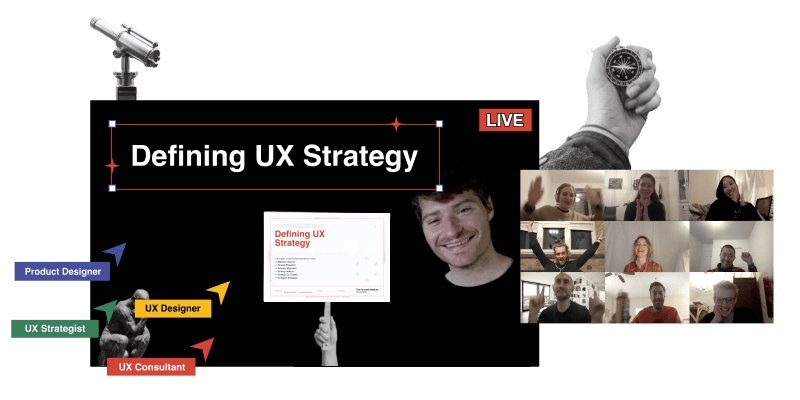
Build a whole new set of strategic skills by learning how to design a UX, design, or product strategy from scratch with videos, live classes, and tons of templates.

![The UX Strategy Template Your Team Actually Needs [Free Canvas]](https://images.squarespace-cdn.com/content/v1/5dc5935a7224ad2839d7e750/1769035489412-65KNDYBSE7B83C4V6CTJ/UX_Strategy_Template-Fountain_Institute%28thumbnail%29.png)


What are some ways that you have found to be a proactive designer?
Drop it in the comments to share your idea!

When AI does the design work, what's left for designers? Strategy. Learn how framing, influencing, and aligning make you irreplaceable in the age of AI.