What is Strategic Design?
An in-depth guide to the emerging role of design in big problem spaces
Reading time: 31 minutes

Jump to a section:
Strategic Design definition ⇣
Where does Strategic Design come from? ⇣
Do Strategic Designers ever design strategies? ⇣
How to Design a Strategy as a Designer ⇣
Strategic Design vs. Design Thinking™️ ⇣
Strategic Design vs. UX Design ⇣
How to Design Strategy ⇣
5 Principles for Strategic Design ⇣
Where Strategic Designers work ⇣
Key components of strategic design culture ⇣
Strategic Design Resources ⇣
It’s 2020 as I write this, and humanity is reeling from the 21st century’s first global pandemic.
Countries across the world have been brought to a standstill. The economy is tanking, unemployment is skyrocketing, and most distressingly, people are dying in huge numbers.
The systems of our world weren’t designed for this.
“There is a deep contradiction to such systems being so strong that they can construct the modern world and yet so brittle that they break within hours. This can, in part, be conceived of as a design problem.”
Why are our systems so fragile? In difficult times we can see which systems are not designed well, but in times of crisis, we can see that many systems were not designed at all. Can the field of design do anything in the face of problems like unemployment, healthcare, and global pandemics?
A movement within design attempts to go beyond user problems to tackle big-picture organizational problems. This movement isn’t about tactical design work, such as designing screens. The practice is all about design as a bridge to better futures.
This movement is called strategic design and is purpose-built for big messy 21st-century problems. It's a future-oriented practice that allows designers to make systemic organizational changes.
How do you define strategic design?
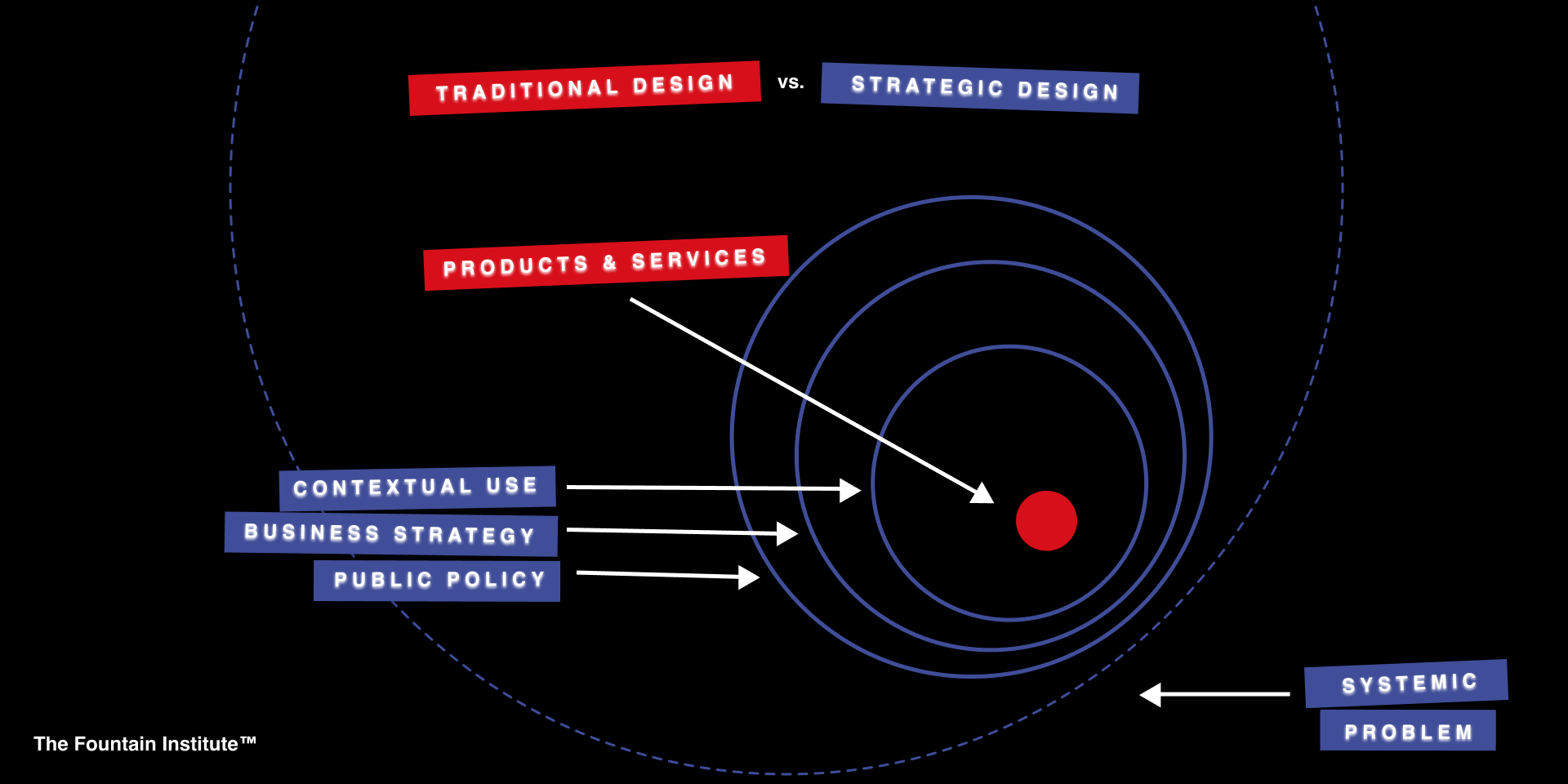
Definition: Strategic design is the application of traditional design principles to systemic problems to strengthen an organization’s strategic and innovative capabilities.
Strategic design aims to arm designers with 21st-century design methods that provide fresh perspectives in the strategic domain beyond tactics and customers. Strategic designers act like connective tissue across teams and disciplines where a design mentality is needed for strategy or innovation operations. The practice is informed by traditional strategy consulting and 21st-century design approaches, such as design research, service design, innovation design, co-creation, and future-oriented practices like speculative design.
“We define strategic design as a professional field in which designers use their design practices to co-determine strategy formulation and implementation towards innovative outcomes that benefit people and organizations alike.”
This emerging approach to design sets out to change the cultures of decision-making and address the problems that don’t have neatly defined clients by embedding designers in strategic positions at organizations.
In a nutshell, strategic design is the best of 21st-century design, dedicated to driving organizational and civic impact, not just user impact.
“Crucially, strategic design takes the core principles of contemporary design practice – user research and ethnography, agile development, iterative prototyping, participation and co-design, stewardship, working across networks, scales and timeframes – and then it points this toolkit at ethical concerns, addressing systemic change within complex systems, and broader societal outcomes.”
It’s yet to be seen if this aim will be achieved across the profession, but what’s certain is the need for a designer who can span multiple business units. In practice, the strategic designer is often found at the intersection of organizational and customer needs, guiding the strategic process of research & co-creation while lending their innovative making skills where needed.
In the in-house corporate setting, strategic designers bridge business and design to innovate within organizations. You also might find them working on innovation teams, discovering new, uncharted spaces in systems that can be leveraged to improve product ecosystems and launch new ventures. In the consultancy world, they might be found leading clients through co-creation and guiding the strategic design process.
Real innovation comes from understanding the complexities around products. Innovative ideas like the Segway or Google Glass were designed well but failed because they didn’t understand culture and policy. You must understand more than the user and the product to create innovation. You have to understand the context.
Strategic design aims to arm designers with 21st-century design methods that provide fresh perspectives in the strategic domain.
Designers recognize the power of design to manipulate ideas into a product, but only strategic designers can manipulate products into systemic change. Big problems like education or healthcare are fuzzy and interdependent, living within the system of products and policy and everywhere in between. Only by designing in the realms of product AND policy will you be able to tackle a problem as big as education or global health.
Strategic design adopts a systems-oriented view of problems. With a systems view, all problems reside within a network with many interdependent factors.
Strategic Designers understand that there are many levers for change within a system. The system of immigration, for example, has levers for change in areas like transportation or healthcare. Systemic problems don’t live neatly within a single department, and strategic designers are uniquely situated to manage solutions across multiple business units.
Where does the practice of Strategic Design come from?
Problem-solving at the system level has always been the aim of design, but systems thinking isn’t traditionally taught to designers. Strategic design aims to apply the problem-solving abilities of design in a bigger playing field dominated by management consultants and policymakers.

Strategic design posits that designers with their human-focused approaches are just as suited to solve humanity’s big problems than traditional strategists, business consultants, and policymakers.
As we’re defining it, strategic design comes from a blend of practices and their intersection with policy as the broader context, most notably the practice of architecture and urban planning.
Until recently, architecture was one of the few design disciplines that required constant partnership with policy due to the amount of regulation inherent in building codes.
Unsurprisingly, the most massive thing humans build creates the most significant change to the environment in which it exists. In the same way, a building can impact a community or neighborhood, strategic design creates a framework for facilitating changes to the culture, policies, and environment with which it interacts.
Strategic design goes far beyond the aesthetics end of the value chain and into the contextual systems involved.
Strategic designers take inspiration from conceptual artists who use objects to challenge the systems we live in. A designed artifact created to enact change in culture is a method shared by conceptual artists and strategic designers.
By imbuing change into something small, strategic designers can construct a Trojan Horse capable of sneaking ideas into much larger systems. An example from the art world: Conceptual artist Olafur Eliasson uses objects from nature. In his work, Ice Watch, he placed glacial ice in the middle of a town square to raise awareness about global warming.
Strategic designers might achieve the same effect through the design of a sustainable business venture that raises awareness around global warming. Both artists and designers use the concept of the Trojan Horse to influence systems.
Do strategic designers ever design strategies?
Yes, strategic designers should design, shape, and adapt strategies as part of their role. Co-determining strategy is one of the many ways strategic designers might try to solve systemic company problems. Not every strategic designer will have this experience because earning the trust to design a strategy from scratch is hard. However, most strategic designers should have worked on a strategy at some point.
Strategy isn’t just for CEOs. Strategy doesn’t belong to any one department, and companies routinely have multiple layers of strategy (called functional or operational strategies). Designers are uniquely positioned to have strategy skills.
Here are some of the skills that many strategic designers use to design effective strategies:
Research
Key to uncovering strategic insights by researching the business and market…not just users
Design Synthesis
Key to connecting complex research data with relevant solutions and going beyond analysis into what might be
Visual Thinking
Key to turning strategic research into tangible artifacts like visuals, models, and artifacts to inspire decision-makers
Problem-Solving
Key to creating sound policies and practical solutions from strategic research
Facilitation
Key to the high amount of collaboration needed to create a strategy or align others to an existing strategy
Policy Design
Key to scaling the strategy’s effect through principles that can have a bigger impact than a single, prescribed action
Experimentation
Key to testing strategy and leading innovation projects that go further than traditional design
Systems Thinking
Key to understanding the system dynamics needed for big-picture changes that strategy seeks to create
Futures Thinking
Key to managing the long-term projects and multiple horizons of strategy projects
Strategic Thinking
Key to leading strategic projects is the ability to go beyond tactics to reach big-picture goals
Of course, a strategy may not always be the right artifact to create systemic change. Luckily, there is no set process that you have to follow to be a strategic designer. Many strategic designers still follow classic design processes like the Double Diamond, but they will customize these design processes for a strategy's non-linear, systemic design.
Strategic designers usually have experience in other design fields before they take the title of strategic designer. The strategic design process is similar to UX, product, and service design, but it’s done on a bigger stage with more interaction with business leaders. It takes a bit of politics to make the tradeoffs necessary for a good strategy, and strategic designers must be skilled at changing hearts and minds through design.
How do you design a strategy as a designer?
Designing a strategy will likely be one of the hardest projects of your life. If it’s your first time, you can make your life easier by designing a strategy for the team you work on. If you’re a designer, that’s probably a design or UX strategy.
So what does the process look like? Luckily, designing a strategy is just like any other design project; you have to research before designing the strategy.
It could take a lifetime to master the process of designing a strategy. And in most cases, contextual expertise will be key. But here is an oversimplified view of the process if you’re designing a strategy at the design level (also known as a functional strategy). It starts with aligning to the higher-order strategies such as the business strategy.
9 steps to creating a design strategy
Start with the strategies above you in the org chart
Translate and align them to your level...these are your constraints
Find the business goal that your managers care about most
Pitch a strategy project that aims to reach that business goal
Research the business, user, and market to uncover barriers to the goal
Share and get your team to agree on the biggest barrier
Come up with three high-level principles that will overcome the barrier
Apply them as a team and study the effect w/ regard to the business goal
Keep iterating until you reach that business goal
Designing a strategy at the design level might look slightly different than when a CEO or an executive does it. You don’t have the authority to determine the organization’s direction, but you can align with it. And you will have to do a lot more research. Resist the temptation to brainstorm your way to strategy, as your first guesses at strategy will be full of assumptions. Do the work to ensure you understand the full landscape and align with the existing strategy to get to a better strategy on your first try.
Want to learn how to design a strategy with guidance from an expert? Take our course on designing strategy at the design level.
Strategic Design vs. Design Thinking™️
While strategic designers may resemble Design Thinking business consultants from afar, the two have very different approaches and practitioners. Design Thinking focuses on training business leaders to “think like a designer,” while strategic design embeds designers in strategic parts of the business.
Strategic design is more of a call-to-arms for designers, while design thinking is a high-level intro to UX design. These Design thinking workshops are sold as a viable alternative to a seasoned in-house expert, but they actually amount to little more than high-priced “executive play dates.”
At best, Design Thinking allows non-designers to understand how designers think. Design Thinking might earn designers a nod in the hallway from executives on their way out of a design thinking workshop. Still, it doesn’t do much for design if business people think they can put on their Design Thinking hats rather than hiring designers.
At worst, Design Thinking cheapens the practice of design. It relegates the job of design to outside Design Thinking consultants rather than embedding designers into strategic positions within the organization.
TL;DR: Strategic design seeks to arm designers with 21st-century design methods, while Design Thinking™️ seeks to arm business people with 20th-century design methods.
Strategic Design vs. UX Design
Strategic design requires a lot of experience, product and service design skills, plus more. Many things change between user experience (UX) design and strategic design, but four significant differences exist.
Difference #1: The space of strategic design is bigger than UX design.
As already stated, strategic design goes bigger than products and moves into policy. What is the scale of strategic design, exactly? That depends on the organization, but it can get as big as a country.
Dan Hill is a strategic designer that has counted the country of Sweden among his clients, and his work approaches some of the biggest problem spaces known to strategic designers. He writes about the scale of strategic design in relation to design practices like interaction and service design. This model provides a helpful guide to how the scale of design grows as you move towards strategic design.

[Scales of Design, a diagram, Dan Hill 2019 Read more about the diagram from Dan Hill here.]
While not perfect, this diagram helps me understand the scale of strategic design, and I have known many designers personally who have transitioned from service design to strategic design. The above diagram is a logical evolution of the UX or service designer.
Difference #2: The time scale of strategic design is longer than UX design.
The bigger problem spaces require longer timelines than traditional projects. Not only will the project last longer, you may also have to “design the transition” between phases since they last so long.
Strategic design is informed by futures practices like strategic foresight, futures thinking, and speculative design. Strategic designers seek to create desirable futures, but they understand that an element of emergence is at play.
The solution you conceive may morph over time, and tending to that change is a vital activity of the strategic designer.
Difference #3: The problems of strategic design are messier and more interdependent.
Rather than simply solving an individual's problem, strategic design seeks to solve the problems of organizations and cultures.
Design as a practice has very humble roots. For most of its history, the design was tasked with swooping in to add artistic decoration at the end of the process. With no creative control over the product being created, applying aesthetics at the end was akin to “adding lipstick to a pig.”

Strategic design goes far beyond the aesthetics end of the value chain and into the contextual systems involved. By moving from the solution space into the problem space, strategic designers can understand the entire ecosystem of a problem. Strategic designers move into the problem space to “consider the whole pig.” A real strategic designer would even consider the farm, the market, and the policy involved in raising pigs.
To zoom out on the organization’s problem space, you need to understand more than the customer’s problems. You also have to understand the ecosystem of problems in the organization.
Research skills can be extremely helpful here as research, analysis, and synthesis are key skills for diving deeper into the problem. Diagnosing the problem is more than half of the battle with designing strategy, so problem-work skills are valuable to all strategic designers.
Difference #4: The solutions are system-level and include principle & policy.
Rather than simply delivering a solution, strategic designers have to design the system that delivers solutions.
UX, product, and service design follow a process of working with problems and solutions (a process known as the Double Diamond). While you can still follow that process, your solutions won’t look the same as product or service design. Over-prescriptive design solutions don’t always go big enough for the systemic change you need in strategic design.
In strategic design, you think bigger than the solution, which means designing on the policy level. Policy doesn’t have to be an internal memo or paper. Strategic designers often use visuals and objects to get creative with policy design. Strategic designers might think of an object, visual, or concept as more of a Trojan Horse for the change they seek to bring to an organization.
The skills of experience design can be extremely helpful when designing policy. Think of it as designing the organizational roadsigns to guide your stakeholders toward the strategic path you’ve set.
How to Design Strategy
Since strategic design is traditional design applied to systemic problems, the process is a mash-up of system design processes and traditional design processes. While traditional design processes are primarily linear, strategic design is decidedly non-linear.
WARNING: There are many possible processes for supporting strategy within organizations. Strategic designers may be pulled into all kinds of strategy work at many different moments of different transitions. Any text-based strategic design process will be reductive, but we think it’s worth showing a possible process.
We don’t claim to have a process for design in strategy, or the work designers do to support strategy in organizations. But the design of strategy has a process. What does that process look like?
The design of a strategy should be a parallel process of research and co-creation.
That’s because a good strategy is based on insights, and stakeholders should vet strategies.
In our course on Design Strategy, we teach a process that is a great entry point into strategy work. Here is what that process looks like in a semi-linear form:

Of course, this isn’t a universal process, but it’s a great starting point. Let’s look at the tracks in more detail.
Research Track
Strategy is a decision-making framework that attempts to solve a systemic organizational problem. Since strategy work looks like problem-solving, you can follow a similar process that you might use in design.
Research your strategy with a variation of these steps:
Framing the challenge
What organizational challenge will you tackle?
Generating insights
What sparks of inspiration help us understand the challenge?
Diagnosing the challenge
What are the critical factors that must be overcome?
Designing policy
What does our system-wide solution look like and how can we implement policy and coherent actions?
Visualizing the strategy
How can we model the learning from our strategy work to make the strategy more useful to stakeholders?
Testing the strategy
How can we test the theories inherent in our strategy so that our strategy is based in reality?
You may not choose to front-load the research phase, and you may jump around between these steps. Take these process steps as inspiration for possible research activities when designing a strategy.
Co-Creation Track
A strategy must be a collaborative effort if it is to be helpful. Don’t be Moses, coming down from your research mountain with a list of new commandments for your team. The strategy should never be a surprise to your stakeholders. Avoid creating a fully-formed strategy that hasn’t been vetted with the team.
Facilitate co-creation of strategy using a variation of these steps:
Establishing shared vision
How can we ensure that everyone is on the same page with the goals of this project?
Exploring the challenge
How can we leverage the knowledge of our team to overcome the challenge?
Framing the diagnosis
How can we focus on the critical factors at play in this challenge?
Exploring solutions
How can design policy with the help of the whole team?
Planning the transition
How can we start to implement this strategy?
Fostering the change
How can we make sure that our planned strategy is a realized strategy?
Stakeholders care about the things they work on personally. Use this to your advantage with the Co-Creation Track.
This dual-track process will vary depending on the organization and the strategic designer involved. Some organizations will have a different metabolism and capacity for strategy work so adapt this process to your organization. Some strategic designers will have stronger skills in research or co-creation so adapt this process to suit your skill level.
Manage Strategy Projects with the Strategy Canvas
Strategy projects can be challenging to manage. You will want a central place to store your research and co-creation work. Use this canvas as a “proto-strategy,” an initial version of your strategy before you add design elements.
Use this canvas as a place to synthesize both your research and your co-creation sessions.

5 Principles for Strategic Design
Strategic designers go a bit further than traditional designers as they design in large-scale projects in big problem spaces. Here are a few principles that can guide your work.
Principle #1: Think in systems.
The first principle of strategic design is zooming out to see the whole picture. Learn to design in a non-linear way so you can design system-wide solutions.
For most of design’s history, it has been a linear process, but the simplification of Design Thinking or the Double Diamond doesn’t work in complex environments.
Designing strategically looks more like designing a rainforest than a car. The complex, interdependent nature means systems is the medium, not a one-way production process.
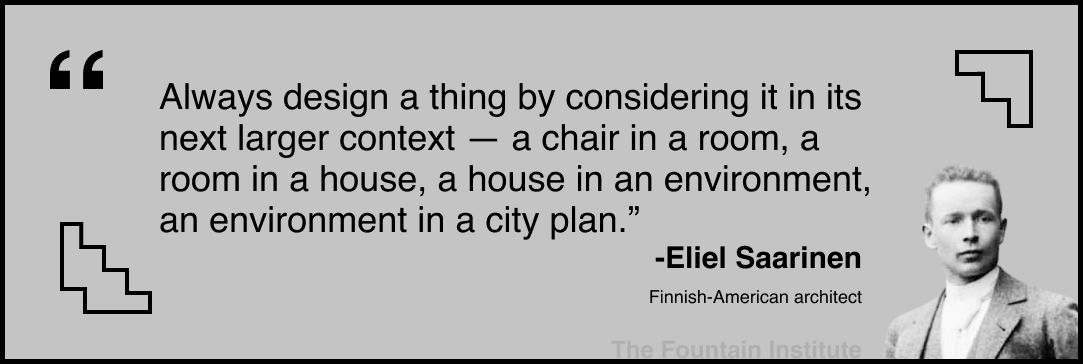
“Always design a thing by considering it in its next larger context⎻a chair in a room, a room in a house, a house in an environment, an environment in a city plan.” -Eliel Saarinen
Principle #2: Make complexity tangible.
Designing big things is still designing, and one of the critical skills is turning hard-to-grasp concepts into tangible artifacts. This tactic of design will be what separates a strategic designer from a normal strategist.
Artifacts like maps, visuals, and storyboards can communicate and change minds, and you can use these same artifacts when tackling big problems. Strategic designers use design tactics to change minds and support decision-making within organizations.
Principle #3: Zoom between tactical and strategic.
Strategic designers should be masters of both tactics and strategy.
Tactical design often happens at the beginning of the designer’s career. Tactics in design include making, creating, and sharing, and they are easily seen and understood by organizations.
The strategy is the "brain-work" that might accompany those tactics, but it is not so easily seen. Examples may include analyzing, synthesizing, translating, and understanding.
For example, Strategic Designers may zoom in to design a new product, but they will also be zooming out to think about the implications of that work in the organizaton. Perhaps that new product will also help usher in a new company policy if it succeeds. Strategic designers would have a system play in mind at all times, and they would embrace tactical work such as making in order to fulfill strategic aims.
Strategic designers often play on both the product and policy levels because systemic problems live on both levels. In this manner, strategic designers zoom back and forth between tactical and strategic work.
Principle #4: Design multiple horizons.
Design is a future-oriented practice, and strategic design projects deal with longer timelines than traditional design. The really big projects deal in multiple horizons because change takes time, and Strategic Designers help drive that change.
Rather than thinking in "launches,” think in transitions. There won't be a clean release of a systemic solution, and there probably won't be a smooth transition either. With system-level work, solutions are never “done.” Strategic designers work toward transformations, rather than arbitrary deadlines and definitions of done.
Always be working towards the next desirable future and take a continuous mindset to manage multiple time horizons.
Principle #5: Facilitate design.
The third principle of designing big is to be collaborative. You shouldn't try to do it on your own. Facilitation is the main skill that Strategic Designers use to bring stakeholders into the strategic design process.
“A facilitator is a person who helps a group of people to work together better, understand their common objectives, and plan how to achieve these objectives, during meetings or discussions.” -Wikipedia
Once you find yourself employed as a strategic designer, you will probably find that much of your time is spent facilitating stakeholders through strategic design activities. While facilitation is a helpful skill for any designer, it is a requirement for a strategic designer because you will need to hyper collaborative.

“We believe that the central responsibility of the designer is to respect and produce a desired impact, and that designing the road is as important as the design itself.” -Merijn Hillen, Jeroen Van Erp, and Giulia Calabretta
For example, your work might shift from delivering clients solutions to facilitating strategy to guide solutions with clients. When designing strategy, your focus is on how stakeholders interact and shape design artifacts.
Where do Strategic Designers work?
Strategic Designers typically work in-house at large organizations. You can usually find them working on the front lines of problem definition in innovative fields at the bleeding edge of tech. Their tasks might include aligning teams with strategic initiatives, co-creating strategic deliverables with high-level stakeholders, or experimenting their way to business model innovation.
Strategic Designers strive to be the drivers of decisions, practices, and behaviors within organizations. They’re often found working at innovation hubs, startup incubators, design consultancies, or anywhere the problem space is still being defined.
As designers, we are used to seeing the world through the lens of the problem solver. As the world becomes more advanced technologically, the problems also become more advanced. Strategic design is the natural evolution of these problems because it’s a design movement set up to understand complex problems and manage system-wide solutions.
We don’t have time to sit around and wait for the perfect client to change the world. It’s time to tackle the problems that are big and messy. It’s time to embrace strategic design as a practice.
What are the key components of a strategic design culture?
What does it look like when design organizations embrace a strategic mindset? In an influential 2010 paper, Julie Hertenstein and Marjorie Platt investigated organizations with strategic design culture and found some unifying themes. They found these four elements were critical to a strategic design culture:
Effectively positioning design
Articulating the design process
Measuring design performance
Integrating design into strategic decision-making
(Hertenstein & Platt, 2010 Wiley)
Other components of strategic design cited in scientific studies are vision, strategy formulation, resources, stakeholder relations, systems perspective, intent-focused thinking, innovation, brand image, integration of design with organizational goals, and integration with competitive positioning.
Strategic Design Learning Resources
Read the book Dark Matter and Trojan Horses: A Strategic Design Vocabulary by Dan Hill
Watch this free masterclass: What is Design Strategy? by Jeff Humble
Use the Strategy Canvas by Jeff Humble to design a strategy grounded in research
Watch an overview video of strategic design by Helsinki Design Lab
Read more about strategic design from designer & urbanist: Dan Hill on Medium
Read the book Strategic Design by Giulia Calabretta, Gerda Gemser, and Ingo Karpen
See a visual book summary of the above called: What is Strategic Design?
See part two of the visual book summary called: How to Practice Strategic Design
Learn how UX designers can be more strategic in this free email course on UX Strategy
Follow the growing collection of resources on strategic design on are.na from Jeff Humble
Learn to design strategy with guidance from experts in six weeks of LIVE online workshops from the Fountain Institute
Watch this free masterclass on designing strategy
Watch this 60-minute webinar and learn how to design a winning strategy for UX, product, or business teams.