UX Strategy vs Product Strategy: What's the Difference?
Understand the relationship between these two disciplines and why it matters for your career.
Reading time: 17 minutes

If you've spent any time in product or design circles, you've probably heard both terms thrown around…sometimes interchangeably.
But UX strategy and product strategy aren't the same thing.
Understanding the difference (and the relationship between them) is essential whether you're a designer looking to grow your strategic influence or a product leader building user-centered products.
In this article, we'll break down exactly how UX strategy and product strategy differ, where they overlap, and why some experts argue the distinction doesn't matter at all.
The Short Answer
"Ok, just give me the quick version..."
Product strategy focuses on what to build and why.
It usually answers questions about product positioning, product operations, competitive advantage, success metrics, and the big one: roadmap prioritization.
UX strategy focuses on how users experience the product.
It usually answers questions about user needs, design operations, interaction patterns, personas, and the end-to-end journey.
Think of it this way: product strategy is the why behind the roadmap. UX strategy is the why behind the user experience.
But here's the thing…that simple distinction hides a more interesting relationship.
Product strategy decides what problems are worth solving. UX strategy decides how to solve them.
How UX Strategy and Product Strategy Relate
“These strategies aren't separate. They're nested.”
Like onions (and ogres), strategy has layers.
The relationship between these two disciplines is best understood visually. UX strategy doesn't sit alongside product strategy…it lives within it.
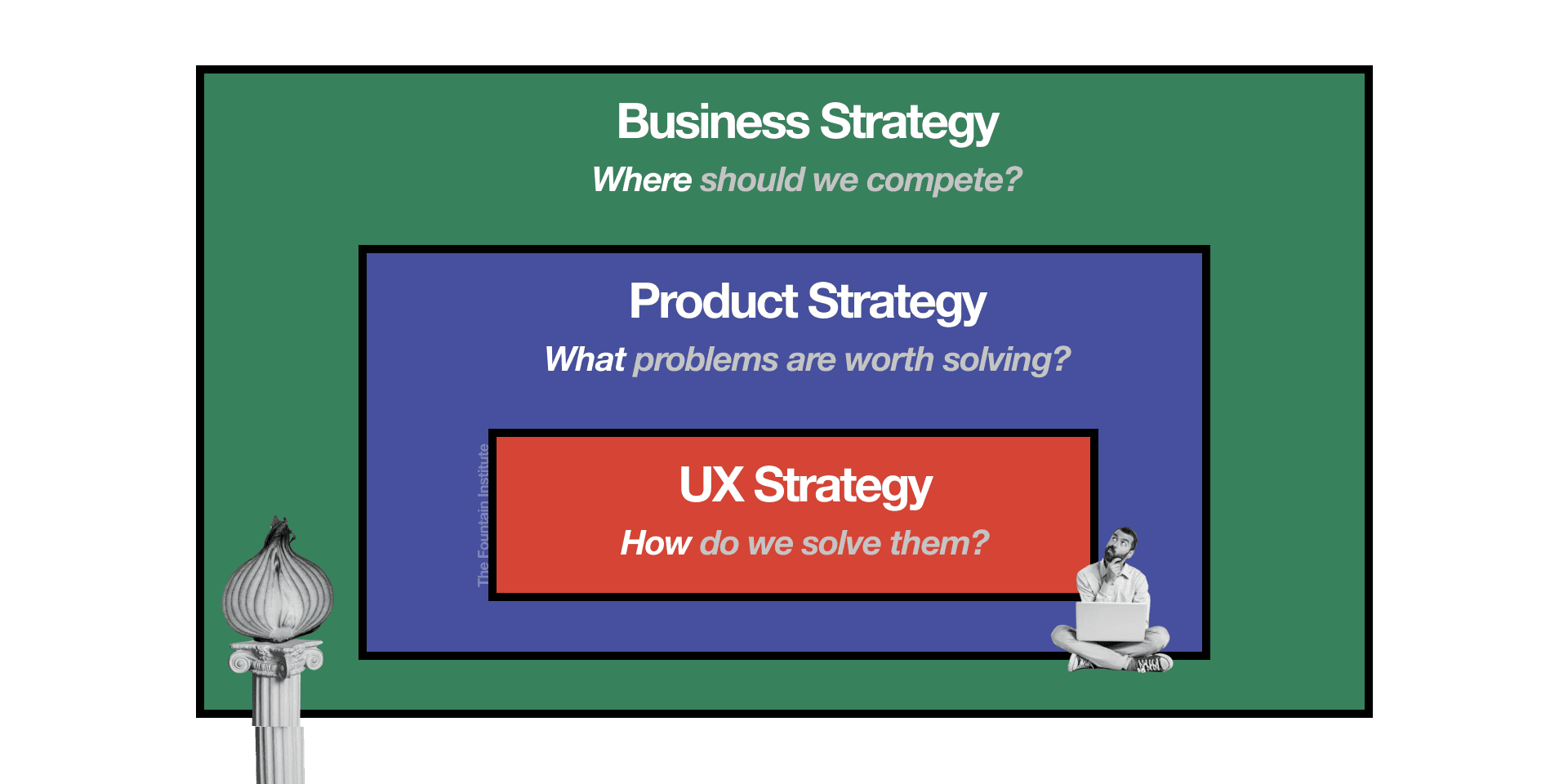
UX strategy is a component of product strategy, which itself is a component of business strategy. Each layer informs and constrains the others.
A brilliant UX strategy means nothing if it's not aligned with what the product is trying to achieve. And a product strategy will struggle if it ignores how users actually experience the product.
Gut check: If your UX strategy exists in isolation from your product strategy, you don't actually have a strategy. You have a wishlist.
UX Strategy vs Product Strategy: A Detailed Comparison
"Let's break down the specifics..."
Here's how the two disciplines compare across eight dimensions:
| Dimension | UX Strategy | Product Strategy |
|---|---|---|
| Core question | "How should users experience this?" | "What should we build and why?" |
| Primary focus | User interactions, flows, emotions | Market positioning, business model, roadmap |
| Scope | The experience layer | The entire product lifecycle |
| Key activities | User research, journey mapping, usability testing, design principles | Market analysis, competitive positioning, feature prioritization, go-to-market planning |
| Typical outputs | Personas, journey maps, experience principles, interaction patterns | Product vision, OKRs, roadmaps, pricing strategy |
| Success metrics | User satisfaction (NPS, CSAT), task success rate, usability scores, retention | Revenue, market share, customer acquisition cost, feature adoption |
| Who owns it | Design leadership, UX leads | Product leadership, founders, CPOs |
| Time horizon | 2-5 year experience vision | 2-5 year product vision |
Notice how the metrics differ. UX strategy tends toward user-centric measures like satisfaction and task success. Product strategy leans toward business-centric measures like revenue and market share.
But the best practitioners track both.
In the UX strategy course, we start the strategy design process with the business metrics and end with the UX metrics. This gives you the best chance of your organization adopting your strategy (and thus caring enough to work to meet user needs).
Where UX Strategy and Product Strategy Overlap
"Actually, UX and product strategy share more than they differ..."
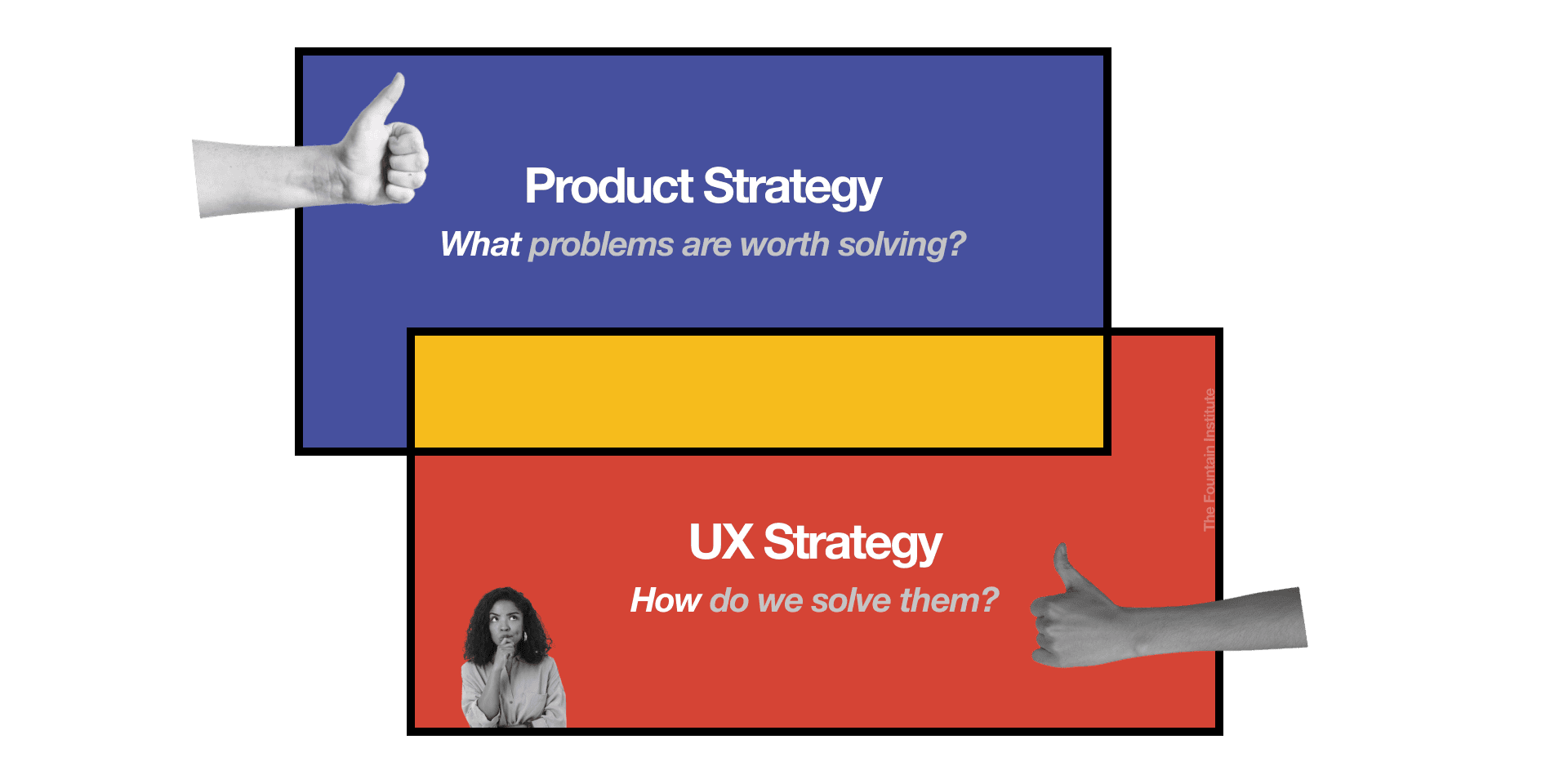
Despite their differences, UX strategy and product strategy share significant common ground.
Both should be user-centered. The user sits at the heart of both strategies. Product strategy identifies user needs to determine what to build. UX strategy addresses those same needs through thoughtful design. Neither can succeed by ignoring the people they serve.
Both are business-oriented. UX strategy and product strategy both require clear, measurable objectives aligned with business goals. A UX strategy without the business context will be generic and trend-based. A product strategy without user empathy is just a feature list.
Both are iterative. Neither strategy is a one-time deliverable. Both involve continuous learning, testing, and refinement based on user feedback and market changes. The best practitioners in both disciplines embrace experimentation and course-correction.
Both require cross-functional collaboration. Product strategists work closely with engineering, marketing, sales, and design. UX strategists collaborate with product managers, researchers, developers, and stakeholders. Success in either role depends on your ability to influence without authority.
Gut check: If you're working on UX strategy without talking to product leadership, or product strategy without consulting designers, you're missing half the picture.
The Debate: Does UX Strategy Even Exist?
“Lean UX author says there's no such thing as UX strategy, making some real drama back in 2014...”
Here's where things get interesting. Not everyone agrees these are separate disciplines.
A quick aside on “design strategy” - You'll sometimes see this term used interchangeably with “UX strategy.” They're close enough that most people treat them as synonyms. If there's a difference, a design strategy can be broader, encompassing brand, visual identity, and how the design function operates within an organization. UX strategy focuses specifically on the user experience, which can also be broader than design. Use the term that makes sense for the team that’s executing the strategy. For this article, we'll stick with "UX strategy" since it's more precise.
But the bigger debate is whether UX strategy should exist at all.
Jeff Gothelf, author of Lean UX, argued provocatively that: “The reality is that there is no such thing as UX strategy. There is only product strategy.”
His point: if your UX strategy isn't deeply integrated with product and business goals, you're doing it wrong. UX decisions made in isolation aren't strategic; they're just design preferences.
Many pushed back on Gothelf’s view. They argued that UX strategy is a legitimate specialization and a focused discipline that ensures the user experience receives dedicated strategic attention rather than being an afterthought to product decisions.
The synthesis
The labels matter less than the integration. Whether you call it UX strategy or product strategy, what matters is that:
User needs inform product decisions
Business goals inform design decisions
Both perspectives are represented at the strategy table
The real danger isn't getting the terminology wrong. It's doing UX work that's disconnected from business reality, or product work that ignores how users actually experience the product.
UX Strategy vs Product Strategy: Career Paths
“Which type of strategy should you learn more about?”
If you're a designer wondering whether to develop “UX strategy” or “product strategy” skills, here's the practical reality:
If you're a designer…
UX strategy is your most direct path to strategic influence. You can start practicing it now, no title change required. Even if you're not a lead, working with UX leadership is far more accessible than trying to get into product strategy conversations.
Product strategy skills are valuable to learn, but getting a seat at that table usually requires either (a) building enough influence through UX strategy that leadership starts including you in product decisions, or (b) moving into a product role.
That said, you can still influence product strategy without a title or seniority. Two approaches that work:
Facilitation. If you know the process and can run a workshop, product leadership often welcomes a neutral guide. You don't need to own the strategy to shape how it gets made.
Research. Testing ideas in a strategy or feeding new user insights into it lets you improve product decisions without having to suggest edits outright.
I teach both of these approaches in my course. They're great ways to start or improve strategy projects when you don't have direct power.
Your title, seniority, and existing influence might matter more than your skills here, so every designer's path will look different. If you're new to strategy, UX is a safer space to get real experience before pushing into product territory.
TL;DR: New to strategy? Start with UX. Have experience and influence with product leadership? Product strategy might be worth your time.
If you're in product leadership…
You likely own the product strategy by default. You don't need to become a UX strategist, but you do need to be aware of UX strategy and know how to leverage your design team effectively. The best product leaders create space for UX strategy to inform product decisions, rather than treating design as a service function that executes after the real decisions are made.
Gut check: Designers, are you building influence through UX strategy, or waiting for permission to do product strategy? Product leaders, are you inviting UX thinking into product decisions, or just handing off specs?
UX and Product Strategy Frameworks
“Frameworks for thinking strategically...”
Check out two popular frameworks in both UX and product strategy.
Jaimy Levy’s Four Tenets of UX Strategy
Jaime Levy's book UX Strategy is the definitive introduction to the discipline. Her Four Tenets framework outlines the key ingredients:
Business Strategy: Understanding the company's competitive advantage and how UX supports it
Value Innovation: Creating new value for users that differentiates the product in the market
Validated User Research: Grounding decisions in evidence about real user needs and behaviors
Killer UX Design: Executing experiences that are both usable and delightful
Levy's framework is comprehensive, but I've noticed designers often struggle to know where to start. They jump straight from goals to tactics, skipping the strategy layer entirely. “We want to increase retention” quickly jumps to “let's redesign the onboarding flow” without a clear strategy connecting the two.
Goals, Strategy, Tactics
I created the Goals, Strategy, Tactics framework to solve the disconnect between goals and tactics that pose as strategy.
Here is what it looks like in UX strategy:
Goals: The business outcomes your UX work needs to support (the why)
Strategy: The clever approach you’ll take to overcome the challenges that stand between you and your goals (the how)
Tactics: The specific design actions and activities that, when coordinated, make the strategy a reality (the what)
The strategy layer is where most designers need the most help. While goals and tactics can be a part of strategy, they’re different things.
UX strategy is the connective tissue between business goals and design activities.
This is one of the frameworks I teach in Defining UX Strategy and explain in depth in What is UX Strategy, Really?. It pairs well with Levy's tenets: her framework tells you what a UX strategy should contain, and this one helps you structure it.
Marty Cagan’s Product Strategy Framework
“Product strategy is all about which problems are the most important to solve.”
That's Marty Cagan, author of Inspired and founder of Silicon Valley Product Group. His framework breaks product strategy into two layers:
Product Vision: The future you want to create (2-5 years out). This is the North Star that aligns all product teams toward the same destination. It should be inspiring and emotional.
Product Strategy: The sequence of problems you'll solve to get there. Not features. Problems. The strategy decides which problems are worth solving and in what order.
Cagan emphasizes four elements of effective product strategy:
Focus: You can't solve every problem. Pick the ones that matter most.
Continuous Insights: Collect qualitative and quantitative data from customers to inform your focus.
Assign Problems, Not Features: Give teams problems to solve, then empower them to find solutions.
Active Management: Adapt as people, timelines, and markets shift.
This is where product strategy and UX strategy connect. Product decides which problems to solve. UX decides how to solve them.
As Cagan puts it, empowered product teams “exist to solve hard problems for your customers and for your business, in ways your customers love, yet work for your business.”
Cagan’s UX-friendly product perspective helps us see the commonalities rather than the differences in UX vs. product strategy.
UX Strategy and Product Strategy: Key Takeaways
The distinction between UX strategy and product strategy is real but nuanced. They're not opposing forces or competing disciplines. They're complementary perspectives on the same fundamental challenge: building products that users love and businesses can sustain.
The most successful products emerge when these perspectives are integrated from the start, not when UX is brought in to "make it pretty" after product decisions are already made.
Whether you identify as a UX strategist, product strategist, or simply a strategic thinker who cares about both users and business outcomes, the key is developing fluency across both domains.
Understand the business. Understand the user. And never stop asking how the two connect.
Gut check: Your company probably has a product strategy. Someone is thinking about what to build and why. But who is thinking about the UX strategy? If you don't have an answer, that's your opportunity.
Want to master UX strategy?
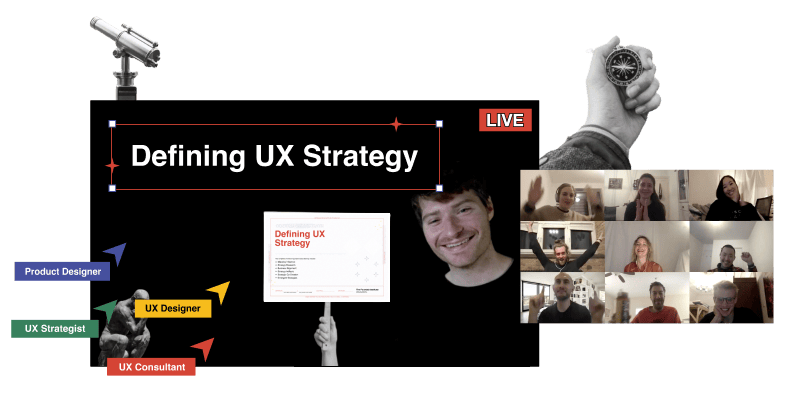
Understanding the difference between UX and product strategy is just the beginning. If you're ready to develop real strategic skills, I teach a course called Defining UX Strategy where you'll learn:
How to align design with business goals
How to research and diagnose strategic challenges
How to facilitate strategy workshops with your team
How to design any type of strategy…whether it’s UX or product strategy
The course includes live workshops, detailed video lessons, and hands-on practice with strategic frameworks. You'll leave with a complete UX strategy you can implement immediately.
Learning Resources for UX strategy
Get a video overview in the UX Strategy Info Session
Get a case study of what not to do in UX strategy in Why Doing Everything is a Bad UX Strategy
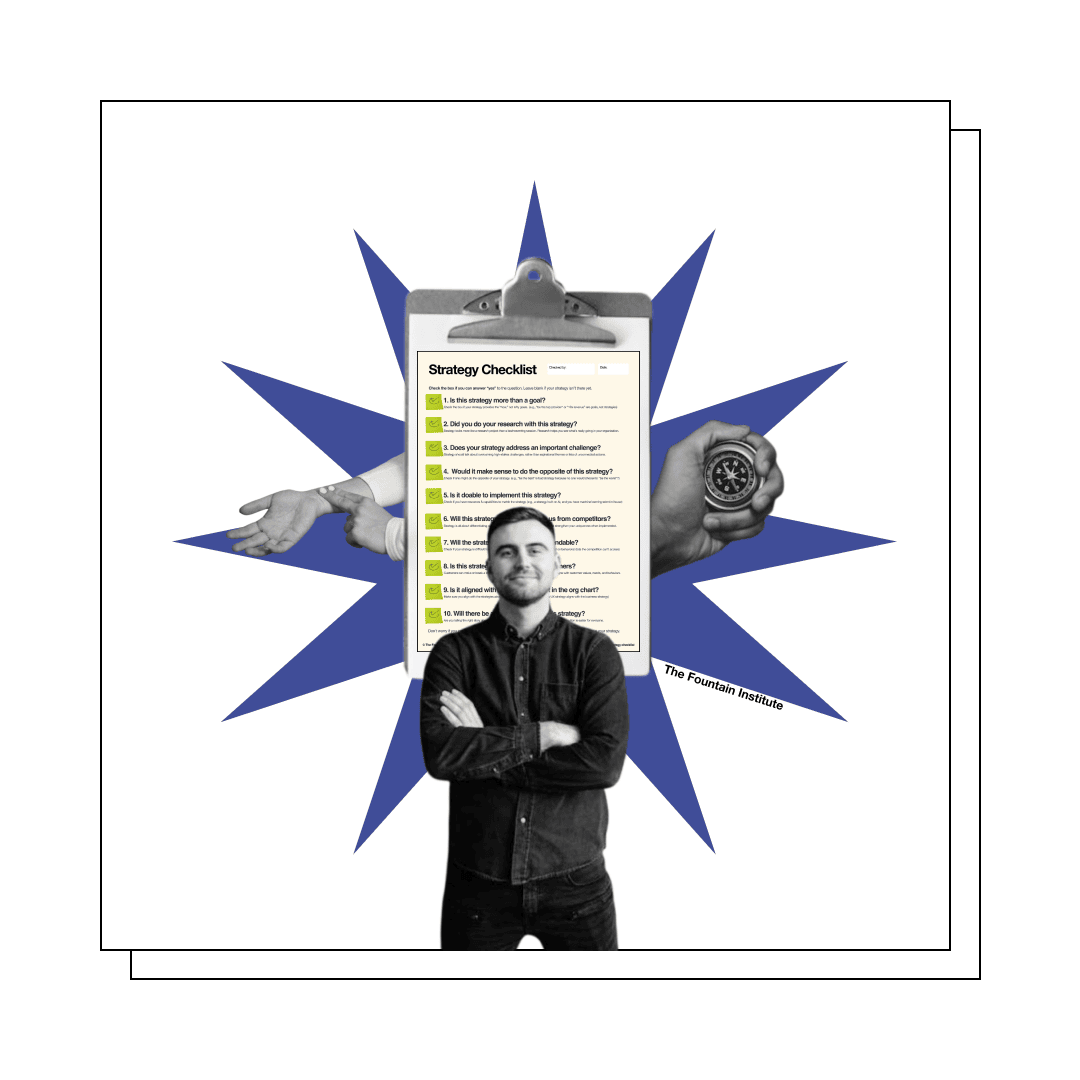
![The UX Strategy Template Your Team Actually Needs [Free Canvas]](https://images.squarespace-cdn.com/content/v1/5dc5935a7224ad2839d7e750/1769035489412-65KNDYBSE7B83C4V6CTJ/UX_Strategy_Template-Fountain_Institute%28thumbnail%29.png)


Have thoughts on the UX strategy vs product strategy debate? Share them in the comments!

When AI does the design work, what's left for designers? Strategy. Learn how framing, influencing, and aligning make you irreplaceable in the age of AI.