What Is Continuous UX Research?
How continuous UX research differs from traditional UX research and how to start doing weekly user research
Reading time: 11 minutes
Amazon releases new production code 23,000 times a day [source]. Why would a company do that? It’s just one website, right?
Today's digital products and services are so complex that their maintenance has become continuous. They require constant iteration...shifting and changing like a complex, living organism.
Companies like Amazon no longer deliver code in a compact disc once a year. It’s been decades since AOL sent us updates via CD. Companies deliver continuously in tiny iterations, and research must also evolve a continuous mindset.
A knowledge worker at a continuous delivery company like Amazon might find themselves drowning in solution work for this lightning-fast production. How can we be proactive and anticipate customer needs if all our time is spent reacting and supporting delivery?
Without understanding customer problems, you might continuously deliver trash that customers don’t want or need. How do we ensure that our product stays connected to the customer?
Continuous UX research is how the top teams are doing it.
How do you define continuous UX research?
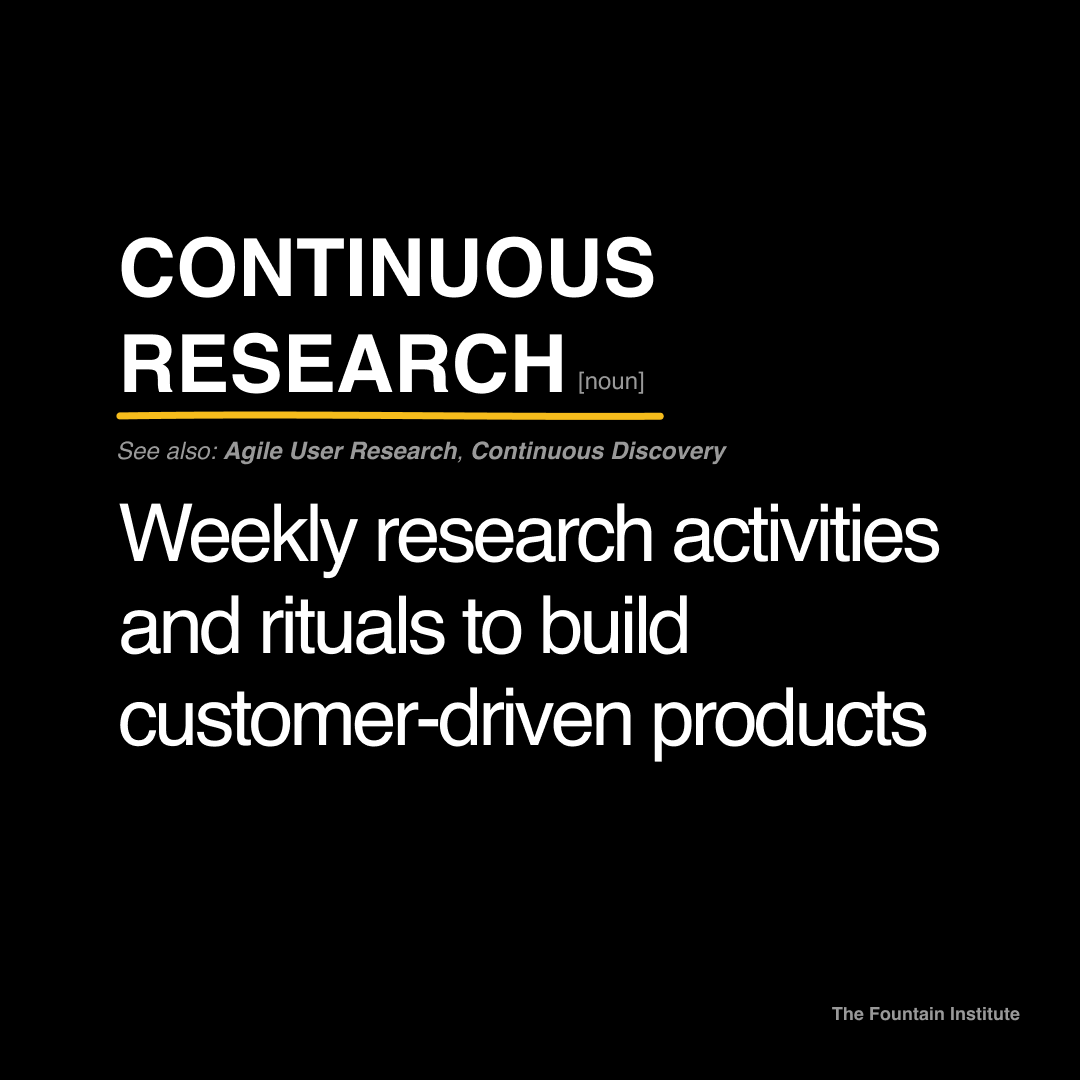
Continuous UX research is weekly user research activities and rituals to build customer-driven products. By taking an always-on mindset to research, you build a comprehensive model of the customer in real-time so you can de-risk product decisions with data.
It’s always-on research that continuously gathers data that everyone can access. Since it’s continuous, it doesn’t require project timelines, briefs, or specific outcomes. Continuous work is done through weekly rituals rather than big projects.
It helps us keep track of customers in a fast-moving world, and it helps us de-risk our design work so we can “design the right thing,” not just “design the thing right.”
This is modern research for modern product teams. The innovations of continuous research come from product teams applying the tools of UX research in highly iterative tech domains.
Continuous research isn’t taught in schools because it's only just emerging into the mainstream, thanks to the work of product teams and multi-disciplinary researchers like Teresa Torres, Tomer Sharon, Erika Hall, and Jeff Gothelf.
Differences between continuous vs. traditional UX research
The emergence of continuous research doesn't mean you stop doing traditional research. These two types of research serve very different purposes and are carried out by two different kinds of roles.

What is traditional UX research all about?
Traditional UX research is project-based and usually starts with a question, topic, or brief. It goes through the process of planning > recruitment > data collection > synthesis > insight presenting > application.
Research specialists carry out traditional UX research, and they usually work in a support role to the teams applying their research. Product managers might start this research to discover requirements for a project, UX designers might do this before a design phase, and UX Researchers might do this in preparation for a future OKR.
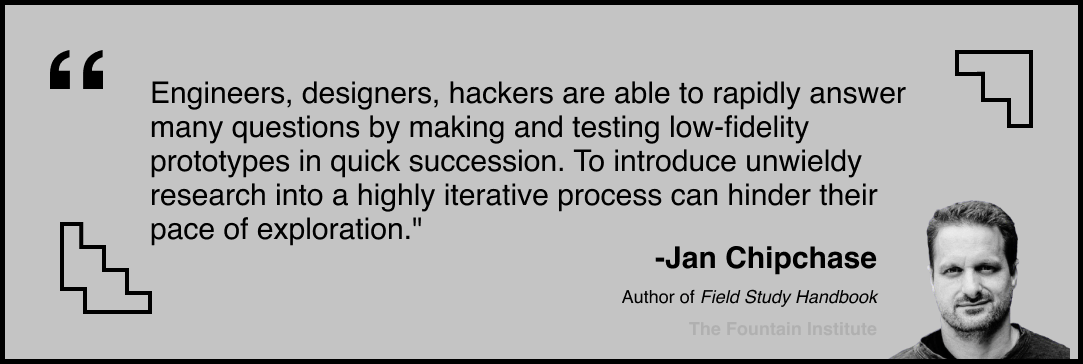
Traditional UX research is in-depth, and the projects often last entire quarters. That makes sense when you want to dive deep and uncover long-term opportunities for the company to explore.
What is different about continuous UX research?
Continuous UX research is product-based and starts with a general desire to improve the product by connecting with the users. Rather than seeking out specific answers or information, it seeks inspiration for the continuous delivery of work.
Continuous UX research is practical, and the learnings are meant to be applied immediately. You don’t need a “project” to do continuous research, but you will need a scheduling tool as the weekly rhythm of the research activities becomes just as important as planning.
Anyone on the product team can conduct continuous research. While the whole team participates, ownership generally follows people with research skills. Since the application of continuous research is so near-term, UX/UI and product designers make great facilitators of continuous research, especially if they have research skills like interviewing and synthesis. If you want to own discovery activities, you will need research skills.
For a deep dive into the skills and methods of a continuous research practice, Watch this webinar on Continuous Research→
How to do continuous UX research
Continuous Research is a complete shift from traditional UX Research with different methods, facilitators, and outputs. Many aspects of Traditional UX Research look slightly different when your team goes continuous.
The project mindset is intermittent.
I call project-based research “traditional” because it’s based on an outdated waterfall project approach. Modern product teams work in agile sprints with as much collaboration as possible. Until now, there wasn’t a genuinely agile methodology for research on product teams.

Even teams with mature research practices had a hard time combining the delivery speed of agile with the discovery processes of UX research. Teams relied on research reports to get up to speed on the customer, and research specialists compiled long reports to help their teams understand the user.
These research specialists are a great way to increase the maturity of the company’s research practice, but this model of research as an asset to be shared by the whole company means researchers are stretched thin. And the insights from research can be easily misapplied by teams without research maturity.
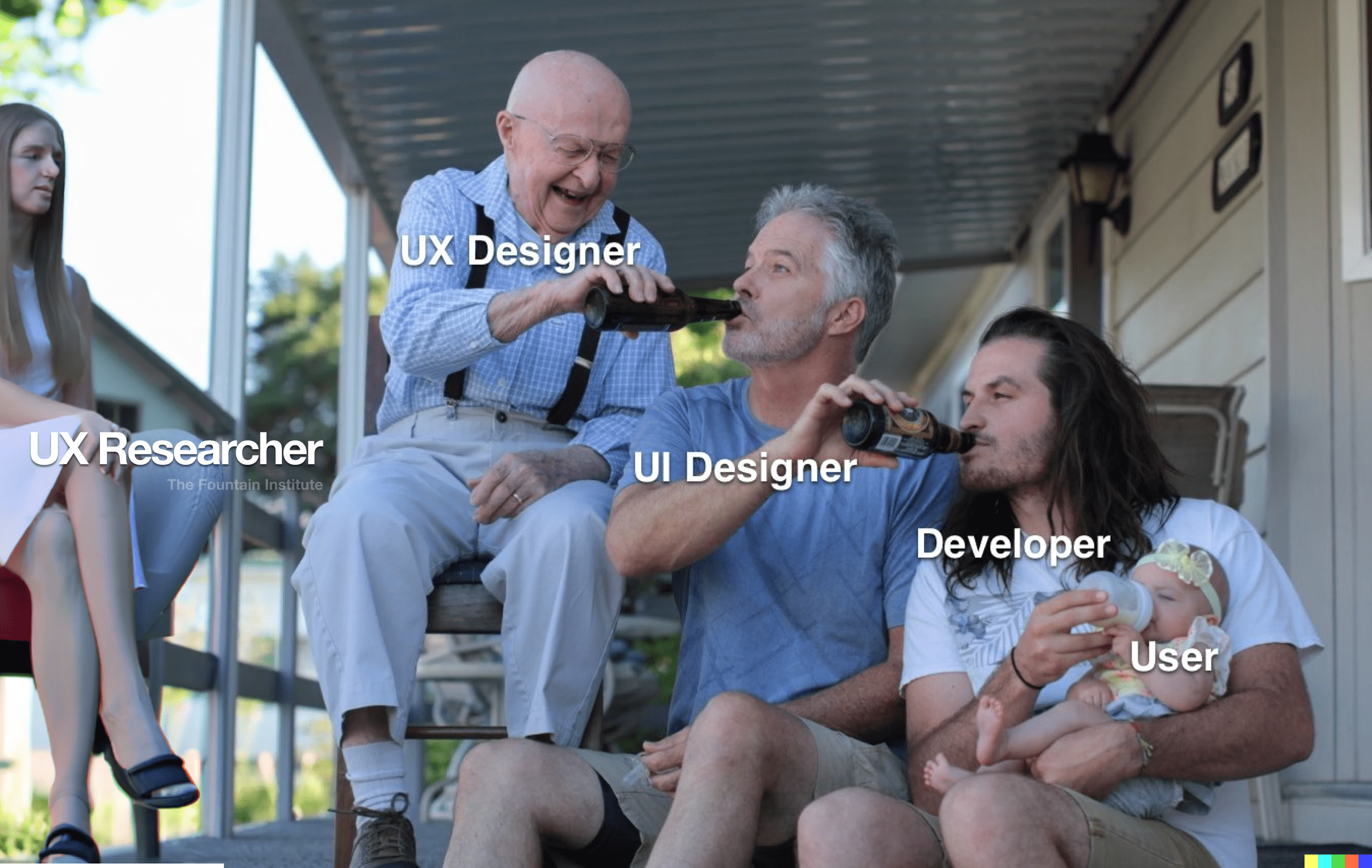
[The full waterfall view, classic UX meme expanded using DALL-E, by Jeff Humble]
Handovers create bottlenecks and slow things down. And like a game of telephone, insights are passed and filtered down until they finally reach the customer.
A new mindset is emerging in UX research. Researchers have begun shifting their roles from delivering insights to increasing research maturity. They embrace the role of facilitators of research and educate their companies. This move towards managing research operations within their organizations is thanks partly to organizations like ResearchOps.
UX research is growing up, and it’s time for a new way to do research that prepares user research for a future where it can be embedded in every product team.
The product mindset is continuous.
Can you imagine an organization that stopped marketing after a big campaign? Can you imagine an engineering team that stopped coding intermittently?
It’s ridiculous to imagine because orgs place so much value on marketing and engineering. Continuous research aims to increase the value of research to this level.
The new mindset in product organizations is a continuous approach to research. As delivery teams become feature factories, continuous research provides a research methodology for customer-driven development.
As you take a product mindset, project planning becomes much more straightforward. You never stop researching. And you do this discovery work alongside your delivery work.
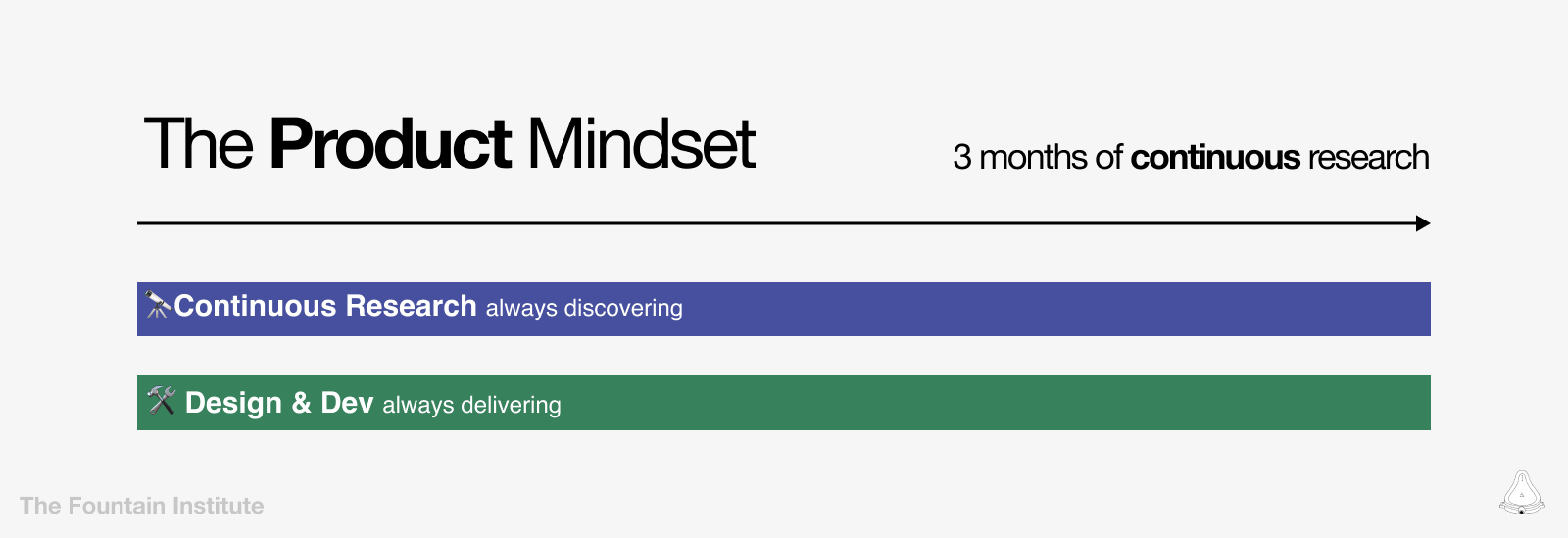
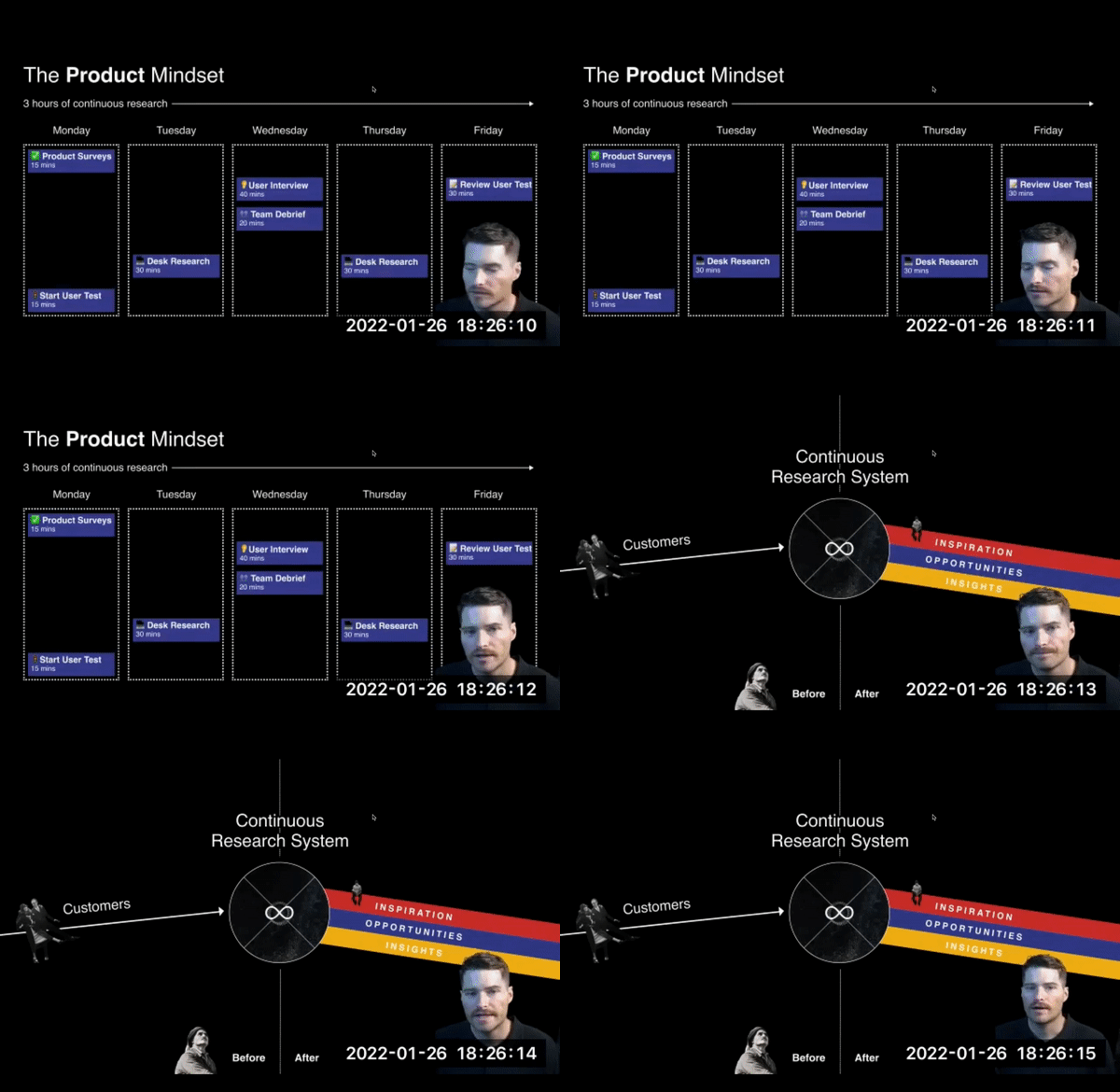
Rather than Gantt charts and complex project management, continuous research sets up weekly research rituals. Here’s what a week of continuous research might look like on a product team:
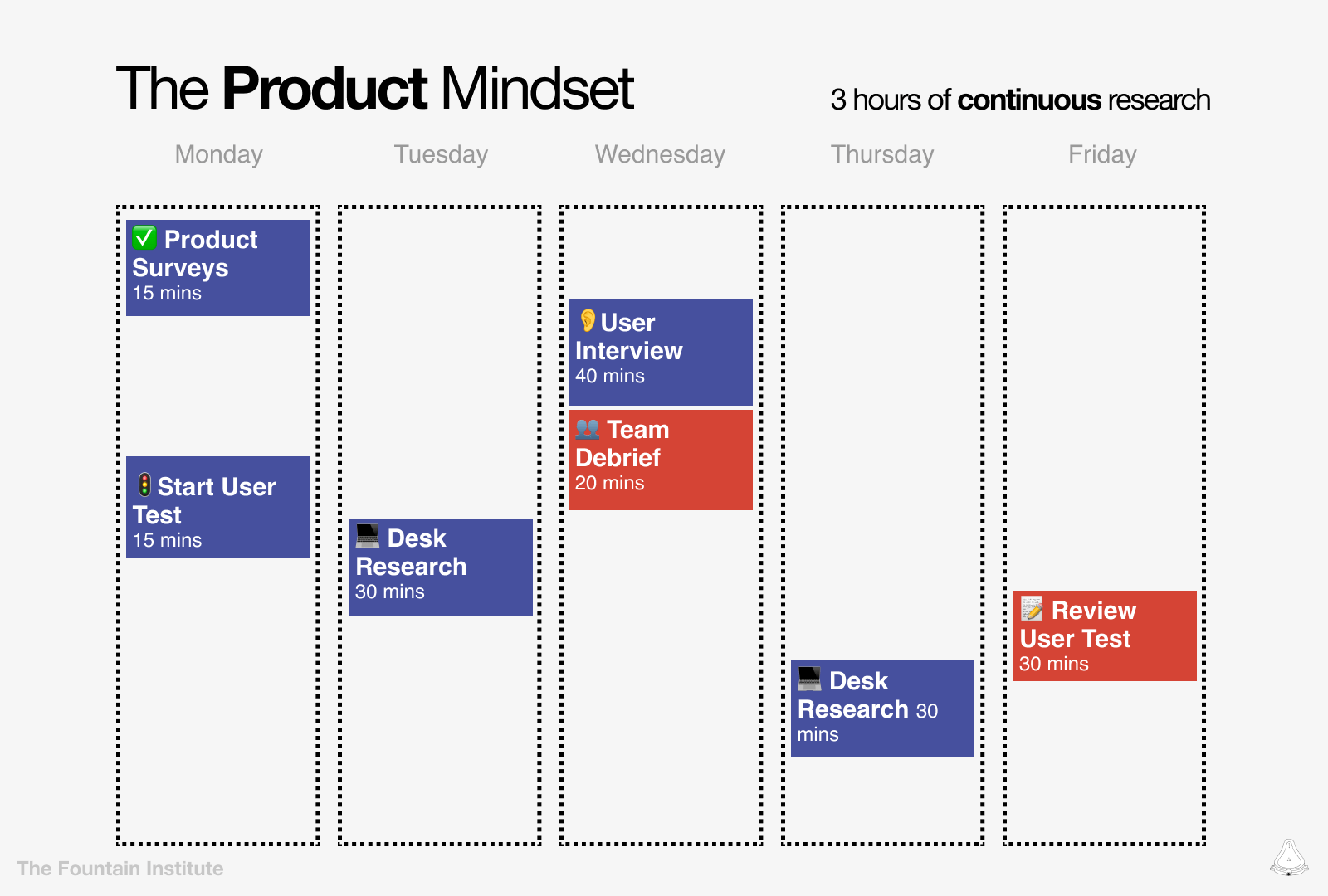
Teams have weekly opportunities to share learnings, making reports less critical for understanding research. Because there are no handovers between research specialists and designers, you don’t need complicated project planning or handover documents like the research report.
Of course, this model requires teams to educate themselves to enable a more decentralized approach to research. Research specialists can aid the lightweight continuous research conducted by teams, while conducting more strategic, long-term research themselves.
If you’ve ever tried to present research, you know the pain of getting the team to read. I don’t think researchers will miss making those 72-page quarterly reports.
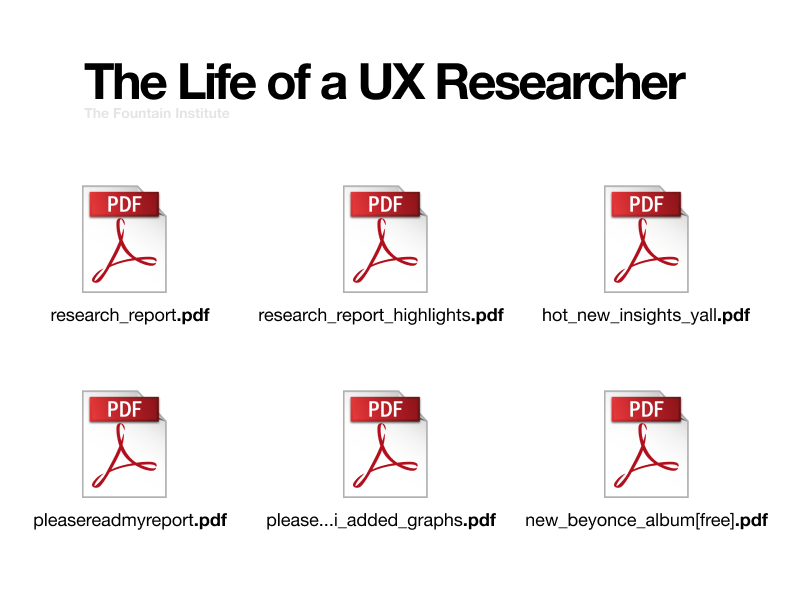
Nobody reads…meme by Jeff Humble
How it feels going from Traditional to Continuous
The transition might feel a bit odd, and your work might look different in some important ways:
Intense → Lightweight
Sporadic → Always-on
Expert-led → Participant-led
Project planning → One-time setup
Quarterly projects → Weekly rituals
Interview scripts → Discussion guides
Long-horizon outputs → Just-in-time inspiration
Project-specific recruitment → Automated recruitment
Presentation of insights → Searchable research repository
Research reports → No reports, team experiences research firsthand!
Is there a difference between “continuous research” and “continuous discovery?”
In practice, there is very little difference between these words. In theory, these words have slightly different meanings and very different origins.
Discovery is the action or process of discovering or being discovered [Oxford]
Research is the systematic investigation into and study of materials and sources to establish facts and reach new conclusions. [Oxford]
“Product discovery” is a popular term for exploratory product research. "Discovery" is based on the drug discovery process of bringing new pharmaceutical products to market [source]. The term comes from consultant and author Marty Cagan, who coined it in 2007 to help product managers understand their real job is discovery, not delivery.
Continuous Discovery Habits by Teresa Torres built on Cagan’s work and brought a very practical and excellent book to the world of product discovery in 2021.
“Continuous” is often used by engineers to mean iterative and consistently delivering. It’s difficult to say who first applied “continuous” to discovery and research. Continuous research draws inspiration from Lean UX and continuous customer feedback. This article from Marnie Andrews dates back to 2013 and mentions continuous user research concepts. Tomer Sharon’s article from 2018 was a high-water moment for continuous UX research.
Continuous research originates in practical applied scientific approaches of the UX research world combined with the rhythm of agile product delivery. Of course, there are deeper roots for these two words. “Research” has roots in science, while “discovery” has roots in colonialism if you look at the word's origin.
Today, the most significant difference between the two terms is who owns them. The UX team owns continuous UX research, while the product team owns continuous discovery.
Who might own continuous UX research:
UX Designer
Product Designer
UX Researcher
Research Operations Manager
Both terms promote sharing of work and data with the whole team. So it’s probably best to use the terms interchangeably.
My advice: use the word your team already uses. And don’t get too hung up on ownership of terms.
After all, there is no “i” in research.
How to get started in continuous UX research
As they say, getting started is better than getting it perfect. If you’re considering continuous research, you should jump in and try it out. The Weekly Customer Interview is known as the “keystone habit” of continuous discovery. Once you get that method right, many other great methods will follow.
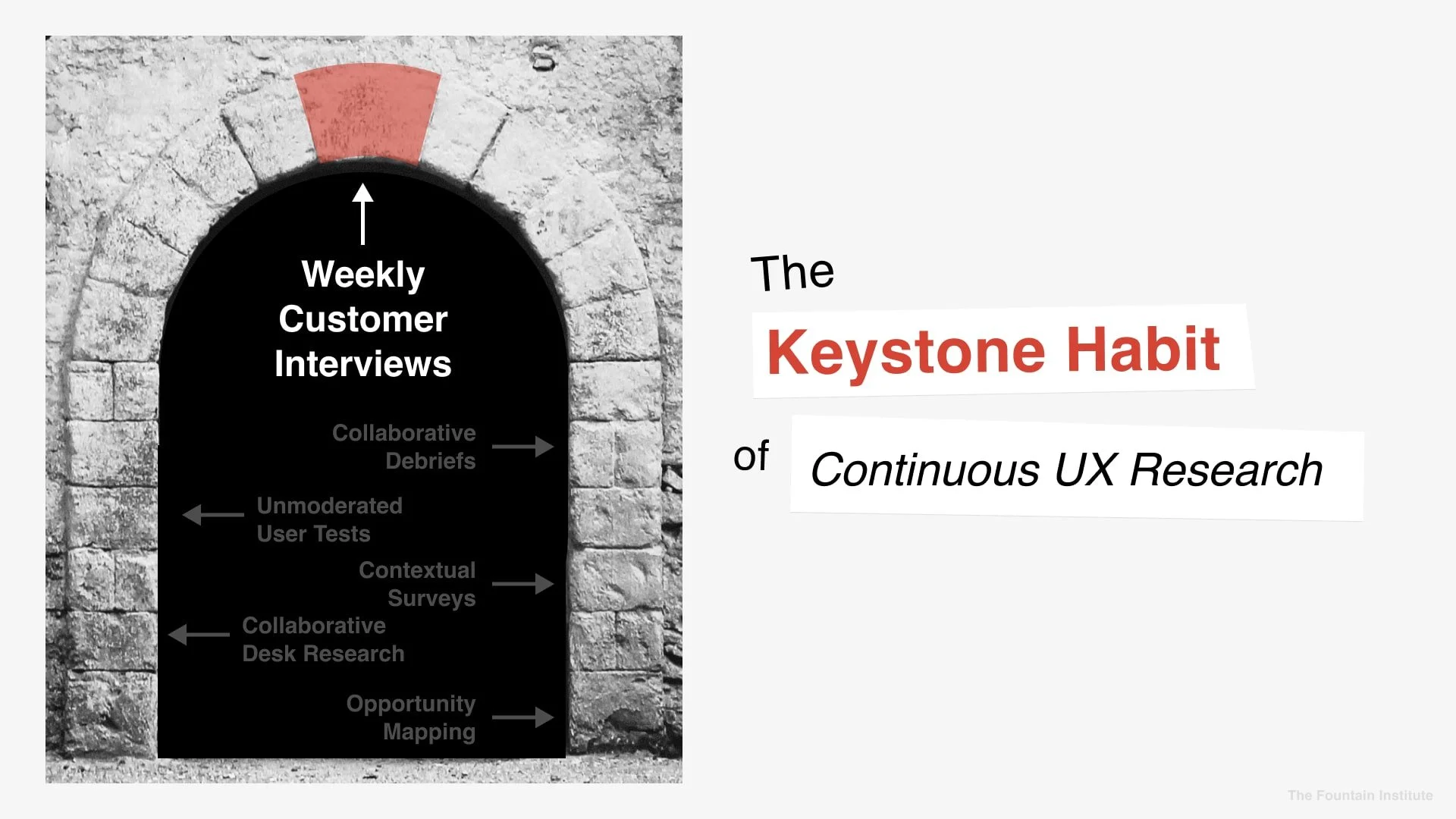
[Learn more about the Keystone Habit of Customer Interviews in this article by Teresa Torres]
Weekly customer interviews are an excellent place to start your continuous practice. Once you figure out how to consistently get face-to-face with customers every week, you can start to tackle more complex weekly research activities.
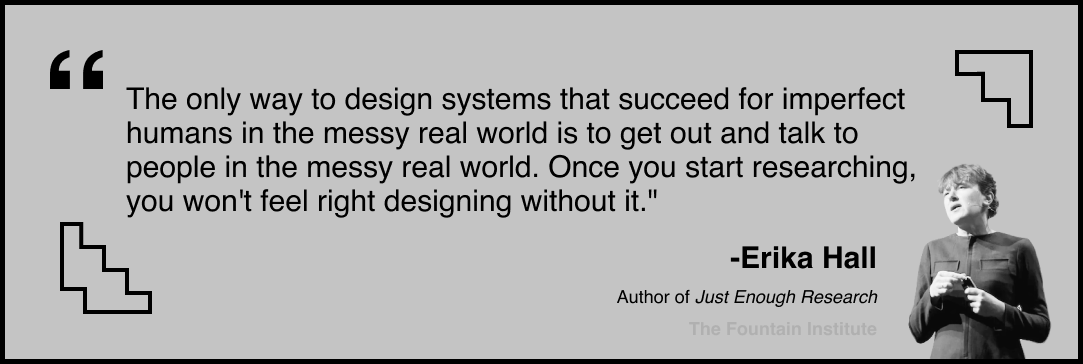
But continuous UX research requires iteration. You must find a few weekly research rituals that will get you to research weekly. You will need to automate and simplify if you want to do impactful research every week. Turning 3-month research projects into a few hours a week requires a lot of setups, automation, and a big mindset shift. It won't happen overnight.
My advice: Don’t pack your week with research all at once. Start small with one weekly research activity and iterate from there.
Why continuous UX research is important
When making important business decisions, you need data fast. And more importantly, you need an understanding of what that data means. You don’t always have time to plan a research project around the fast-paced decisions of tech products and services.
Continuous UX research seeks to create a constant stream of valuable customer data. With an always-on approach to customer data, we all make better decisions.
Continuous UX research is a methodology that seeks to arm everyone with the tools for an up-to-date understanding of the people that use our products and services.
It’s a way to democratize research so that we can all become experts on the customer.
Learn more about Continuous UX Research
Learn Continuous UX Research LIVE and online in a series of 10 interactive workshops
Read The Methods of Continuous Product Teams by Jeff Humble
Read Continuous User Research in 11.6 Seconds to learn more about Continuous Research from the creator of the Atomic Research Nugget, Tomer Sharon
Learn more about Continuous Research in this overview article by Isabelle Woytal
Read The Fantastical World of Continuous User Research by Great Question
Read Continuous Discovery and learn more about Continuous Delivery and Continuous Discovery from the founder of Discovery, Marty Cagan
Read The Best Continuous Discovery Teams Cultivate These Mindsets by Product Coach, Teresa Torres
Read The Role of User Research in a Continuous Discovery World by Teresa Torres
Get a Masterclass in Continuous UX Research
Watch this 60-minute webinar and learn how to do weekly research with your team. This talk will prepare you to implement your system for research operations with the methods and processes you need to research every week.